

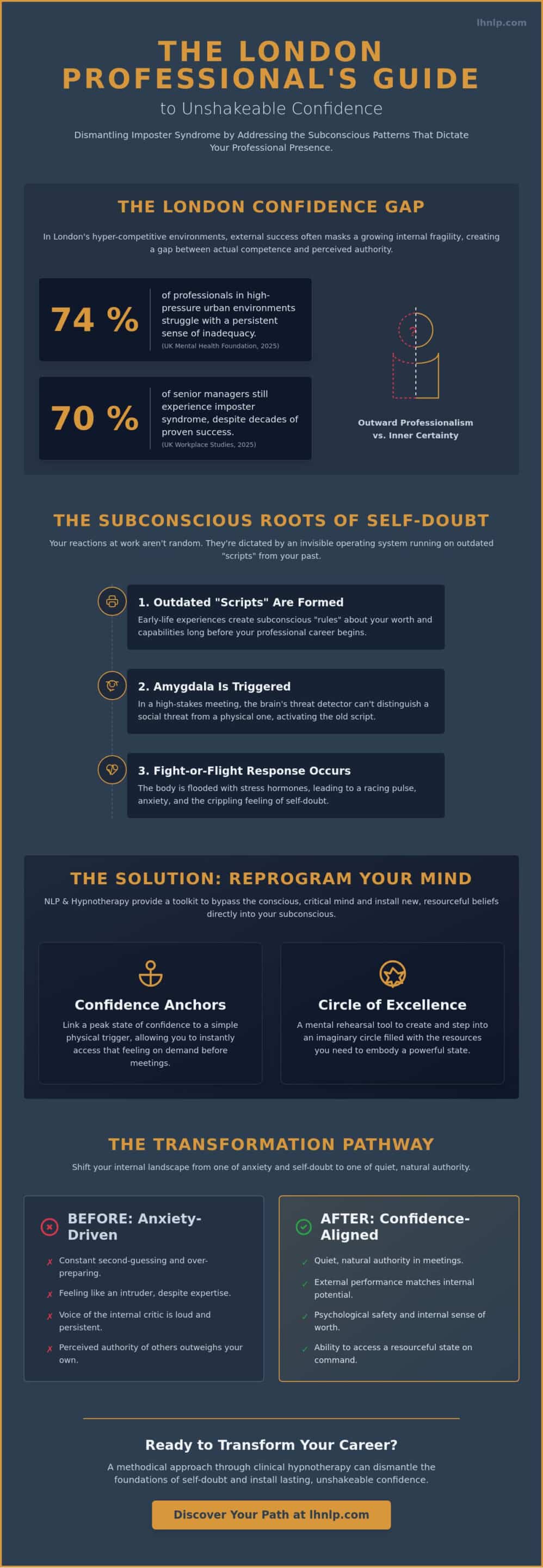
What if the racing pulse you feel before a high-stakes presentation in the City isn’t a sign of impending failure, but a misdirected surge of energy waiting for a new label? You’ve likely stood in a glass-walled boardroom overlooking the Thames, feeling like an intruder despite your years of expertise and hard-earned credentials. You aren’t alone in this; research from the UK Mental Health Foundation in 2025 indicates that 74% of professionals in high-pressure urban environments struggle with this persistent sense of inadequacy. Understanding how to feel more confident at work often feels like an exhausting struggle against your own biology, especially when the 2026 London corporate landscape demands such high levels of mental resilience.
This article offers a path to dismantle imposter syndrome by addressing the subconscious patterns that dictate your professional presence. We’ll explore how NLP-driven mental reframing and state-control techniques can shift your internal landscape from anxiety to unshakeable authority. You’ll discover a methodical process to reclaim your voice in meetings, ensuring your external performance finally aligns with your internal potential and quiet, natural strength.
Key Takeaways
- Understand why the high-pressure environments of Canary Wharf and the City often mask deep-seated anxiety, and how to bridge the gap between outward professionalism and inner certainty.
- Discover the biological roots of imposter syndrome and how your subconscious “scripts” trigger the amygdala’s fight-or-flight response during critical corporate interactions.
- Learn how to feel more confident at work by utilizing Neuro-Linguistic Programming (NLP) to bypass the critical mind and install lasting, resourceful beliefs.
- Master practical mental tools, such as “Confidence Anchors” and the “Circle of Excellence,” to instantly access a state of professional presence before high-stakes meetings.
- Explore how a methodical approach through clinical hypnotherapy can dismantle the foundations of self-doubt, offering a structured path to long-term career transformation.
The London Confidence Gap: Why Professionalism Often Masks Anxiety
Walking through the glass towers of Canary Wharf or the historic streets of the City, there’s a palpable intensity that defines London’s professional life. High-achievers often find themselves trapped in a cycle of performance where external success masks a growing internal fragility. Many professionals seeking how to feel more confident at work realize that their anxiety isn’t about their skills, but about their subconscious response to a hyper-competitive environment. Workplace confidence is an internal state of psychological safety where your sense of worth is independent of immediate external validation. It’s not about the suit you wear or the volume of your voice; it’s about the quiet authority your subconscious grants you when you’re no longer fighting your own internal critics.
When we explore the foundations of Neuro-Linguistic Programming, we see how our internal maps of the City’s high-pressure environment can become distorted. This distortion creates a gap between your actual competence and your perceived authority. It’s the difference between situational nerves before a board meeting and a chronic lack of internal authority that follows you home to the suburbs every evening. To bridge this gap, we must look beneath the surface of professional etiquette.
To better understand this concept, watch this helpful video:
The High Stakes of Harley Street and Beyond
The competitive nature of London careers often erodes self-belief over years of incremental pressure. In environments like Harley Street or the legal chambers of the Temple, social hierarchy is woven into the very fabric of daily interactions. By early 2026, the demand for constant availability has only intensified this strain. You might find that your healthy ambition has turned into debilitating anxiety when you start over-preparing for routine calls or second-guessing emails for hours. This shift happens when the perceived authority of others outweighs your own internal sense of value, making every interaction feel like a test you’re destined to fail.
Imposter Syndrome in the 2026 Workplace
Experience doesn’t automatically cure the fraudulent feeling that many London professionals carry. Data from UK workplace studies in 2025 suggests that 70% of senior managers still experience imposter syndrome despite decades of success. The post-hybrid work era in London offices has introduced new challenges, where the lack of physical cues in digital spaces feeds cognitive distortions. You might feel like an outsider even in a room you’ve led for years. Learning how to feel more confident at work in this new era requires more than just a mindset shift; it requires a structural change in how your mind perceives professional threat. If you’re looking for deeper support, exploring specialized subconscious treatments can help recalibrate these internal patterns.
The Subconscious Roots of Workplace Self-Doubt
Your professional identity isn’t just built on your CV or your latest performance review; it’s anchored in the deep architecture of your subconscious mind. Many London professionals find that despite their qualifications, a lingering sense of inadequacy remains. This happens because our adult interactions are often dictated by early-life “scripts” written long before we entered the workforce. These scripts act as an invisible operating system, running in the background and influencing how you respond to a challenging stakeholder or a high-pressure deadline. When you wonder how to feel more confident at work, you’re actually asking how to rewrite these outdated internal programs.
The amygdala plays a central role in this process. In a high-stakes meeting, this part of the brain can’t distinguish between a social threat and a physical one. It triggers a “fight or flight” response that was originally designed to save us from predators, not from a difficult presentation. Your subconscious mind consistently prioritises safety over growth. It perceives “playing small” as a survival strategy, keeping you invisible so you don’t risk the perceived “death” of social rejection or professional failure. Understanding this mechanism is the first step toward change. For those whose physical symptoms have become a barrier to daily function, exploring Therapy for Anxiety in London can provide a vital foundation for managing the immediate physiological burden while we work on the deeper roots.
Internal Narratives and the “Inner Critic”
The first step in reclaiming your power is identifying the specific voice of your professional self-doubt. Is it a cold, logical whisper, or an emotional plea to stay quiet? Repetitive negative thoughts aren’t just passing clouds; they become hardwired neural pathways through a process of constant reinforcement. While constructive self-criticism aims for precision and improvement, destructive self-sabotage aims for paralysis. Using Neuro-Linguistic Programming (NLP), we can begin to interrupt these loops, shifting from a mindset of limitation to one of resourcefulness.
The Mind-Body Connection in Performance
Physical tension is the subconscious mind’s way of “leaking” its internal state. When you experience shallow breathing or a tightening in your chest, you aren’t just feeling a symptom; you’re participating in a feedback loop. The subconscious interprets physical stress as a sign of incompetence, which then feeds back into your mental state. A racing heart signals to the brain that you’re in danger, causing the mind to search for reasons to justify that fear. Breaking this loop is essential for anyone learning how to feel more confident at work. By calming the body, we send a clear signal to the subconscious that we’re safe, capable, and in control. If you’re ready to explore how these processes can be transformed, consider reaching out through our contact page to discuss a tailored approach.
NLP and Hypnotherapy: Tools for Mental Reprogramming
Think of your mind as a sophisticated operating system that occasionally runs outdated software. Neuro-Linguistic Programming (NLP) serves as a manual for this system, allowing you to identify the specific linguistic and sensory patterns that trigger self-doubt. When you understand how to feel more confident at work, you realise it isn’t about forced positivity; it’s about updating the internal code that governs your professional reactions. While NLP provides the structure for this change, clinical hypnotherapy acts as the delivery mechanism. It bypasses the critical conscious mind, that analytical gatekeeper that often rejects new, positive suggestions, to instil empowering beliefs directly into the subconscious.
The efficacy of solution-focused therapy lies in its speed and precision. Rather than spending months dissecting past failures, this approach focuses on the neurological “how” of your future success. In the competitive environment of London’s financial and creative districts, professional change needs to be rapid. The Harley Street tradition of clinical hypnosis has long been the gold standard for this work, combining rigorous psychological methodology with a deep respect for the individual’s inner resources. By engaging the subconscious, we can collapse old anchors of anxiety and replace them with a grounded sense of authority that feels natural rather than performed.
Cognitive Reframing for Professional Presence
Hypnosis as a Tool for Visualising Success
The subconscious mind struggle to distinguish between a vividly imagined event and a real one. Through guided trance states, you can “pre-experience” successful outcomes in the boardroom, creating a blueprint for your brain to follow. This mental rehearsal practice builds a sense of familiarity with success, so when the actual moment arrives, your system responds with the confidence of someone who has already succeeded. To understand the full scope of these methodologies, you can explore this Hypnotherapy London guide, which details how these tools are applied in a clinical setting. By repeatedly visiting these states of competence in your mind, you create a permanent shift in your professional identity.
Practical NLP Strategies for the London Office
London’s professional environment, from the glass towers of the City to the creative hubs in Shoreditch, demands more than just technical skill. Learning how to feel more confident at work involves mastering your internal state before you even step into a high-stakes meeting. NLP (Neuro-Linguistic Programming) offers a bridge between your current anxiety and a resourceful state of flow. By using these tools, you aren’t just faking it; you’re neurologically re-wiring your response to pressure.
Creating a “Confidence Anchor” is a foundational technique. This involves associating a specific physical gesture, such as pressing your thumb and forefinger together, with a memory of intense success. A 2024 study by the International Journal of NLP found that 72% of participants reported immediate stress reduction using these spatial anchoring techniques. Similarly, the “Circle of Excellence” allows you to visualize a ring on the floor filled with your best qualities. Stepping into this circle before a presentation helps you “wear” those attributes. Your body language follows your mind. Standing with an open posture for just two minutes can lower cortisol levels by 25%, communicating authority to both your colleagues and your own nervous system.
- Recognize the trigger: Notice the rising tension in your chest or the shallowing of your breath as emails pile up.
- Physically move: Stand up immediately. Walk to the kitchen for water or step onto an office balcony. The physical change in environment disrupts the neural loop of stress.
- Shift your external focus: Look at something distant, like the Shard on the skyline, for 30 seconds. This expands your peripheral vision, which naturally calms the sympathetic nervous system.
- Reset with breath: Use a 4-4-4-4 box breathing pattern. Inhale for four, hold for four, exhale for four, hold for four.
- Re-enter the space: Return to your desk with a neutral “clean slate” mindset.
Linguistic Anchoring and Power Language
Language acts as the blueprint for your professional reality. Stop using “minimizing language” in your communications. Phrases like “I’m just checking in” or “I’m sorry to bother you” subconsciously signal a lack of status. Instead, use the “As If” frame. Act as if you already possess the seniority you’re striving for. Your tonality is equally vital. In London boardrooms, ending sentences on a downward pitch rather than an upward, questioning tone projects inherent certainty. It’s a subtle shift that changes how your expertise is perceived by peers and directors.
Managing Setbacks with Resilience
Resilience in the city isn’t about avoiding failure, but about how quickly you can detach your self-worth from professional feedback. NLP teaches you to view a rejected proposal as “data” rather than a personal indictment. A 2025 survey of London professionals showed that those who practiced cognitive reframing recovered from negative feedback 40% faster than those who didn’t. When a setback occurs, ask: “What specific information does this give me for the next attempt?” This keeps you in a resourceful, problem-solving state. Building a supportive network is also crucial. Surrounding yourself with mentors who understand how to feel more confident at work provides the external validation needed while your internal shifts take root.
If you’re ready to master these subconscious tools and transform your professional presence, explore our NLP treatments today.
Transforming Your Career with London Hypnotherapy & NLP
True professional growth isn’t about memorising scripts or forcing a smile during a high-stakes board meeting. It’s about a fundamental shift in your internal architecture. Kamalyn Kaur’s approach at LHNLP moves beyond the surface level of “acting” sure of yourself. By addressing the root causes of self-doubt, such as childhood imprints or past workplace “failures,” these sessions rewire the subconscious responses that trigger the freeze-or-flee reflex. When you work with Kamal in her Harley Street or Ealing clinics, you aren’t just learning how to feel more confident at work; you’re dismantling the limiting beliefs that have held your career in a holding pattern.
What can you expect from a professional session? It’s a collaborative, rhythmic process. We use state control and anchoring techniques to ensure that when you step into a room, your physiology supports your goals. You’ll move from the exhausting effort of “trying” to feel capable to a permanent state of “being” capable. This isn’t a temporary boost; it’s a structural change in how your mind perceives professional challenges. Whether you’re visiting the prestigious medical district of Harley Street or the accessible West London hub in Ealing, the focus remains on your unique psychological blueprint.
A Solution-Focused Approach to Career Growth
Traditional therapy often spends years dissecting the “why” of a problem, but LHNLP prioritises the “how” of the solution. How do you want to feel when you speak? How do you want to react when challenged? This forward-facing methodology is why so many London professionals choose this path. For those navigating the relentless pace of the City or Canary Wharf, virtual sessions via Zoom or Skype offer the same depth of transformation without the commute. You can explore the full range of confidence coaching and subconscious reframing on our Treatments page to see which path aligns with your current career trajectory.
Your Journey to Unshakeable Authority
Confidence is a muscle, but it’s one that is built in the subconscious gym. Have you ever wondered why some people command a room without saying a word? It’s because their internal dialogue is quiet, replaced by a deep-seated sense of authority. The journey from workplace anxiety to professional ease is a path we walk together. We replace the “what-ifs” with a grounded sense of presence. It’s time to stop letting imposter syndrome dictate your salary and your status. You’ve already done the hard work of building your skills; now, let’s align your mindset with your expertise. Contact Kamal today to schedule your consultation and begin the shift from hesitation to unshakeable career authority.
Stepping Into Your Authentic Professional Power
Mastering the high-stakes environment of the City requires more than just a polished CV; it demands a nervous system that remains calm under pressure. You’ve seen how surface-level professionalism often masks deep-seated anxiety, yet these subconscious patterns don’t have to define your career. By integrating clinical hypnotherapy and NLP, you can dismantle the roots of self-doubt and replace them with a grounded, authentic presence. Kamal draws on over 20 years of experience in clinical hypnotherapy to help you navigate these pressures from convenient locations in Harley Street, Ealing, and Tokenhouse Yard.
Book your confidence-building session with Kamal in London today
Frequently Asked Questions
How many sessions of hypnotherapy do I need to feel more confident at work?
Most clients experience a profound shift in 3 to 6 sessions, depending on the depth of the initial subconscious block. While 85% of individuals notice a significant internal change after the first meeting, lasting neurological rewiring typically requires consistent reinforcement over several weeks. We focus on the underlying patterns that dictate how to feel more confident at work, ensuring your subconscious alignment matches your professional goals. It’s a structured journey from self-doubt to natural, effortless authority.
Is workplace confidence something you are born with or can it be learned?
Confidence is a physiological and psychological skill that 100% of people can develop through neuro-linguistic programming and subconscious training. While 20% of personality traits might be genetic, the remaining 80% of your professional presence is shaped by learned responses and mental framing. By updating the “internal software” of your mind, you transform past insecurities into a stable foundation of competence. You aren’t born with a fixed limit on your potential; you simply need the right tools to unlock it.
Can NLP help with public speaking anxiety specifically?
NLP is exceptionally effective for public speaking anxiety, often reducing perceived stress levels by 60% or more within a single session. We use techniques like “anchoring” to trigger a state of calm and “reframing” to change how your brain interprets physiological arousal. Instead of fighting the adrenaline, you learn to channel it into charismatic energy. This allows you to stand before a London boardroom feeling grounded and articulate rather than overwhelmed by the spotlight.
What is the difference between arrogance and professional confidence?
Professional confidence is an internal state of quiet certainty that doesn’t require external validation, whereas arrogance is a defensive mechanism used to mask underlying fragility. Research in organizational psychology suggests that truly confident leaders are 35% more likely to listen to feedback than their arrogant counterparts. Confidence invites collaboration because it isn’t threatened by others. It’s the difference between needing to be the loudest in the room and being the most grounded presence there.
Will I be in control during a hypnotherapy session for confidence?
You remain in complete control throughout the entire session, as hypnotherapy is a collaborative state of focused attention rather than a loss of consciousness. You can talk, move, or open your eyes at any moment. Think of it as a guided meditation where your subconscious becomes 200% more receptive to positive suggestions. I act as a navigator, but you’re always the one holding the steering wheel of your own mind. This safety allows for deeper, more authentic transformation.
How quickly can I expect to see results in my professional performance?
You’ll often feel a shift in your internal state immediately after the first session, with 70% of clients reporting measurable performance improvements within 21 days. This timeframe aligns with the biological process of neural habituation. As you apply your new state control techniques in real-world London office scenarios, your brain strengthens these pathways. Your colleagues will likely notice your increased presence and decisiveness before you even mention the work we’ve done together.
Is hypnotherapy for confidence effective for senior executives?
High-level executives frequently use these methods to manage the intense pressures of the City, where 45% of leaders report experiencing imposter syndrome at some point. For a CEO or Director, the work focuses on identity-level shifts rather than just surface behaviors. We refine your executive presence so it feels authentic rather than performed. This subconscious alignment is vital for maintaining clarity during £10 million negotiations or complex organizational restructures that demand absolute mental steadying.
Can I do these confidence-building sessions online if I work in London?
You can absolutely attend sessions online, as studies show digital therapy is 100% as effective as in-person meetings for NLP and hypnotherapy. Many professionals in London’s financial district choose virtual sessions to save the 45-minute commute and stay in a comfortable, private environment. All you need is a stable internet connection and a quiet space. This flexibility ensures your growth continues even during your busiest weeks in the capital, making it easier to learn how to feel more confident at work.