

What if the persistent hum of worry you experience while crossing London Bridge isn’t a personality trait, but a measurable state of your nervous system? Many of us in the City treat chronic restlessness as a badge of office, yet the gad-7 assessment reveals that for the 37% of Londoners reporting high anxiety levels in recent ONS data, this “background noise” is a signal that requires professional attention. You likely know the feeling of a racing mind that refuses to switch off once you leave the office, or the physical tension that settles in your shoulders during the evening commute. It’s an exhausting way to live, especially when you fear that seeking help might be seen as a weakness in such a competitive environment.
You deserve to understand the mechanics of your internal state and, more importantly, how to reclaim your sense of peace. This guide explains how the gad-7 screening tool functions, what your specific results indicate about your mental health, and how to access expert support in the heart of London. We will move beyond the numbers to provide a clear roadmap for recovery, helping you bridge the gap between your current stress and a future of composed, confident living.
Key Takeaways
- Understand why the gad-7 is the gold standard screening tool used by London GPs and how it accurately tracks the frequency of your anxious thoughts.
- Learn to interpret your score on the 21-point scale to identify whether your symptoms require self-monitoring or professional intervention.
- Discover the specific pathways available in the heart of London, from NHS Talking Therapies to specialised private support.
- Explore how addressing the subconscious roots of anxiety through NLP and hypnotherapy can facilitate a deeper, more rhythmic internal change.
- Gain the confidence to move beyond mere symptom management and begin a methodical process of reclaiming your emotional well-being.
Understanding the GAD-7: A Londoner’s Tool for Measuring Anxiety
Living in London often feels like being part of a high-speed engine that never shuts down. Between the Northern Line commute and the relentless pace of the City, we frequently dismiss our racing hearts as just another part of the day. The Generalized Anxiety Disorder 7 (GAD-7) offers a necessary pause. It’s a validated 7-item self-report scale that serves as the clinical benchmark for GPs and therapists across the UK. By providing a structured way to measure what often feels like an invisible weight, it helps us bridge the gap between “getting on with it” and recognising when our internal state requires professional attention.
To better understand how this assessment works in a clinical setting, watch this helpful video:
In a city where 1 in 4 people will experience a mental health problem each year, the line between healthy ambition and clinical anxiety often blurs. We’ve normalised the 10-hour workday and the constant state of “alertness” required to navigate Canary Wharf or Soho. The gad-7 doesn’t just measure stress; it identifies the persistent, excessive worry that characterises Generalised Anxiety Disorder. It’s the primary tool used by the NHS to determine if your symptoms meet the threshold for clinical intervention, ensuring you aren’t just managing the noise but addressing the root cause.
The History and Validity of the GAD-7
Developed in 2006 by Drs. Robert L. Spitzer, Janet B.W. Williams, and Kurt Kroenke, this tool was designed for speed without sacrificing accuracy. Its brevity is its greatest strength for busy professionals who don’t have hours for lengthy assessments. Research published in the Archives of Internal Medicine confirmed its 89% sensitivity for detecting GAD. It’s equally effective at screening for Panic Disorder and Social Anxiety, making the gad-7 a versatile first step in any mental health journey.
Why Self-Screening is the First Step to Calm
Using this test requires you to look back at the last 14 days of your life. It transforms vague feelings of unease into objective data points. When you walk into a consultation at one of London’s many medical practices, having your score ready allows you to advocate for yourself with clarity. It moves the conversation from “I’m feeling a bit overwhelmed” to “My score indicates moderate anxiety.” This shift in framing is a powerful act of self-leadership that opens the door to effective treatments and lasting change. It’s about taking ownership of your mental landscape and deciding that “London stress” shouldn’t be your permanent state of being.
Decoding the Seven Questions: What the GAD-7 Really Measures
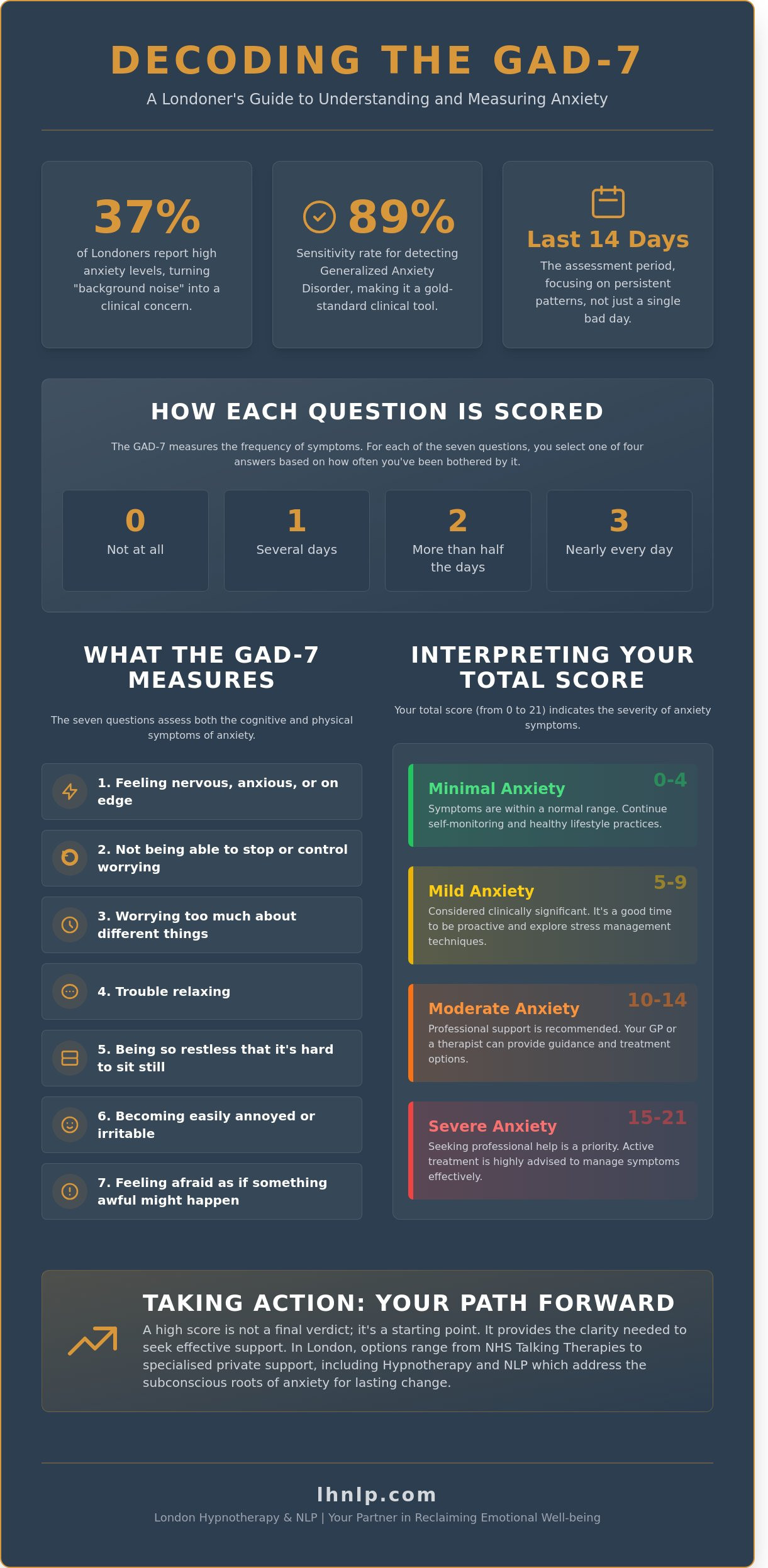
The gad-7 isn’t a personality assessment or a measure of your character; it’s a clinical snapshot designed to track the frequency of specific emotional and physical states. It operates on a four-point Likert scale where you score yourself from 0 (not at all) to 3 (nearly every day). This structure shifts the focus away from how “intense” a feeling is and instead looks at how much of your life it’s currently occupying. By measuring the last 14 days, the tool identifies persistent patterns rather than fleeting reactions to a singular bad day at the office.
The scientific weight behind this tool is significant. The original GAD-7 validation study demonstrated that this seven-item scale has an 89% sensitivity for identifying generalised anxiety disorder. It works by monitoring both the cognitive “chatter” of the mind and the physical restlessness that often accompanies a dysregulated nervous system. When you look at your score, you’re seeing a reflection of your current state control and how much your internal resources are being taxed by the environment around you.
Analysing Worry and Emotional Control
Questions 1 and 2 focus on the feeling of being nervous or on edge and the inability to stop worrying. In the “always-on” culture of London’s financial and creative sectors, where 60-hour weeks are common, these feelings are often incorrectly badge-worn as professional dedication. You might find yourself trapped in “anticipatory anxiety,” where your mind is constantly rehearsing future crises before they’ve even happened. This mental rehearsal drains your cognitive energy, making it nearly impossible to remain present during a strategy meeting or a family dinner.
Physical and Social Manifestations of Anxiety
The gad-7 also looks at how your body betrays your internal stress level. Questions 4 and 5 ask about trouble relaxing and being so restless that it’s hard to sit still. These behaviours manifest clearly during a 35-minute commute on a crowded Central Line carriage or when you’re unable to stop tapping your pen during a high-stakes boardroom presentation. Your body is essentially stuck in a “fight or flight” loop, even when there’s no physical danger present.
- Question 6: Becoming easily annoyed or irritable.
- Question 7: Feeling afraid that something awful might happen.
Irritability in the workplace is often a masked symptom of GAD, acting as an unconscious defensive shield when your emotional bandwidth is completely exhausted. If you find that your “fuse” has shortened significantly over the last fortnight, it’s rarely about the people around you and more about the internal pressure you’re carrying. If these patterns feel familiar, learning more about our specialised treatments can help you begin the process of recalibrating your nervous system.
Interpreting Your Scores: Mild, Moderate, and Severe Anxiety
Understanding your gad-7 score is the first step toward reclaiming your internal state. This tool provides a numerical value for your experience, ranging from 0 to 21. According to the original GAD-7 validation study, specific cut-off points identify the severity of symptoms with high clinical accuracy. These numbers aren’t just labels; they’re indicators of how much your nervous system is currently over-indexing on perceived threats.
- 0-4: Minimal Anxiety. You’re likely experiencing the standard ebb and flow of life without significant disruption.
- 5-9: Mild Anxiety. This range is common among London professionals. It suggests you’re carrying a heavy cognitive load that requires monitoring before it compounds.
- 10-14: Moderate Anxiety. We consider this the “tipping point.” At this level, your symptoms likely interfere with your sleep, productivity, or relationships.
- 15+: Severe Anxiety. This score indicates a high level of distress. It’s a clear signal that your current coping mechanisms are overwhelmed and professional intervention is necessary.
When ‘Normal’ Stress Becomes a Problem
Many Londoners in high-pressure roles normalise a score of 8 or 9 as “just part of the job.” However, the sensitivity of the gad-7 means a score of 10 or higher requires a formal evaluation. It’s vital to distinguish between generalised worry and specific triggers. For instance, if your anxiety focuses intensely on physical symptoms or illness, you might be experiencing health anxiety rather than GAD. Recognising this nuance allows us to tailor the therapeutic approach to your specific mental architecture.
The GAD-7 as a Progress Tracker
In our London clinics, we don’t just use these scores for initial assessment. We use them as a compass for your journey. We often ask clients to retake the test every 28 days to observe trends in their mental state. Seeing a score drop from a 16 to an 11 over a month is a powerful motivator. It proves that your brain is relearning how to access calm. This measurable shift is why many choose to integrate NLP and hypnotherapy into their recovery. These methods work directly with the subconscious to lower those numerical values by changing your underlying response to stress. When you see the numbers decline, you stop feeling like a victim of your nerves and start feeling like the architect of your own peace.
Beyond the Test: Taking Action if Your Score is High
A score above 10 on the gad-7 is a clear message from your nervous system, not a permanent identity. It’s a snapshot of your current internal state. If your results suggest moderate or severe anxiety, the first step is to acknowledge this data without judgment. High cortisol levels in a city like London are often a byproduct of our environment, where the constant hum of the Tube and the relentless pace of professional life keep the “fight or flight” response on a hair-trigger. Your score is a compass, not a cage; it points toward the areas of your life that require more gentle attention and structural change.
In the UK, your GP is the primary gateway to clinical support. They can refer you to the NHS ‘Talking Therapies’ programme, which provides evidence-based interventions like Cognitive Behavioural Therapy (CBT). While these services are vital, waiting lists in London boroughs such as Tower Hamlets or Southwark can often stretch beyond 12 to 18 weeks. If you feel you need to address your state more urgently, looking into private options or self-directed neurological retraining can bridge that gap. You don’t have to wait for a crisis to begin the process of recalibrating your mind.
Approaches like neurofeedback therapy, for example, work by directly training brain function to create calmer response patterns. Even if you’re not in the Netherlands, you can learn more about Neurobics to see how this technology is applied to anxiety.
Online coaching can also be an accessible way to build the skills needed to manage the digital stressors that often contribute to anxiety. For example, while its focus is on helping Kiwis, the digital confidence coaching from Achieve With Nate provides a model for how to navigate the online world with greater calm and self-assurance, no matter your location.
Professional Support Options in London
Clinical diagnosis identifies the condition, but therapeutic support focuses on the mechanics of your change. Private centres in Harley Street or the City of London provide faster access, often offering consultations within 48 hours. When you book a session, bring your gad-7 results as a talking point. It provides a concrete baseline that helps a practitioner understand the intensity of your symptoms immediately. This saves time and allows the conversation to move quickly toward practical state control and emotional reframing.
Self-Help Strategies for Immediate Relief
Managing the sensory overload of London requires “digital boundaries.” Turn off non-essential notifications to stop the constant drip of adrenaline caused by news alerts and emails. On your commute, use grounding techniques: identify four textures you can feel or three distinct sounds beneath the city noise to pull your awareness back to the present moment. Sleep is your most powerful tool for emotional regulation. If your mind won’t shut down at night, read our guide on how to cure insomnia to restore your natural rest cycle.
Transformation begins when you decide that your current state is no longer your only option. You have the internal resources to shift how you process the world around you. To begin your journey toward a calmer, more centred version of yourself, explore our targeted anxiety treatments and discover how we can help you regain control.
Holistic Recovery in London: How Hypnotherapy and NLP Transform Anxiety
A high gad-7 score often serves as a wake-up call for many Londoners. While traditional talk therapy provides a space to vent, it doesn’t always provide the tools to stop the cycle of worry at its source. At London Hypnotherapy & NLP, we move beyond just discussing the problem. We focus on how your mind constructs anxiety in the first place.
Our approach targets the subconscious mind; the engine room where those automatic “what if” thoughts originate. For a busy professional working in the City or a creative in Ealing, waiting months for incremental change isn’t always an option. You need a shift that matches the pace of your life. By addressing the neurological patterns that keep your gad-7 score elevated, we help you transition from a state of constant “red alert” to one of composed clarity.
The NLP Approach to Anxiety
Neuro-Linguistic Programming (NLP) treats anxiety as a process rather than a permanent trait. We examine the internal dialogue that drives your stress. Is that voice loud, fast, or coming from a specific direction? By altering these “sub-modalities,” we strip the power from anxious thoughts. You’ll learn to re-pattern the mental loops that lead to physical tension. This isn’t just about coping; it’s about reclaiming a sense of agency over your emotional landscape. Most clients notice a shift in their internal narrative within the first three sessions.
Hypnotherapy for Deep Calm and Resilience
Clinical hypnosis allows us to bypass the critical conscious mind, which often gets in the way of healing. It creates a state of focused relaxation where we can install new, calmer responses to old triggers. We offer a bespoke approach led by Kamalyn Kaur, focusing on solution-based outcomes. You can learn more about us and our methodology to see how it aligns with your personal goals for recovery.
If your schedule makes it difficult to visit our Harley Street or Ealing clinics, we provide virtual hypnotherapy sessions. These are just as effective as in-person consultations, allowing you to access expert support from the comfort of your own home. Whether you’re dealing with a score of 5 or 15, your journey to a quieter mind begins with a single conversation. You can book a consultation today to start the process of lowering your anxiety for good.
Transform Your Anxiety into Inner Stillness
Your gad-7 score isn’t a static label; it’s a diagnostic compass that helps you navigate the complex terrain of your inner world. By understanding the nuances of your results, you’ve moved from a place of uncertainty to one of informed clarity. This test provides the essential data needed to recognise when professional intervention becomes the most compassionate choice for your future self. What would change in your daily life if you could finally quiet the persistent noise of “what if” and reclaim your mental space?
Real change requires moving beyond data into the realm of the subconscious where habits of worry are formed. At my Harley Street practice, I’ve spent over 20 years refining a solution-focused approach that combines NLP and hypnotherapy to help Londoners break free from the grip of chronic tension. We don’t just manage your symptoms; we work together to reframe your internal state and install new, resilient patterns of thought. You’ve already done the hard work of looking at the numbers. Now, it’s time to experience the profound shift that happens when your mind finally feels like a safe place to be.
Book Your Anxiety Consultation in London Today
You possess the internal resources to thrive; let’s unlock them together.
Frequently Asked Questions
Is the GAD-7 a formal medical diagnosis for anxiety?
The GAD-7 is not a formal medical diagnosis but a clinical screening tool used to identify potential symptoms of anxiety. While it measures the severity of your emotional state, a definitive diagnosis requires a consultation with a qualified professional, such as a GP or a psychiatrist. They use clinical interviews and diagnostic criteria from the ICD-11 to confirm a condition. Think of the score as a compass pointing toward a direction rather than the final destination of your journey.
Can I use the GAD-7 to measure social anxiety or panic attacks?
While the gad-7 specifically targets Generalized Anxiety Disorder, it doesn’t provide a detailed map for social anxiety or panic attacks. Research indicates it captures about 70 percent of symptoms related to other anxiety subtypes, yet it lacks the granularity needed for specific phobias. If your heart races in crowds or you fear social judgement, supplementary tools like the SPIN scale offer a more precise reflection of those internal landscapes.
What should I do if my GAD-7 score is 15 or higher?
A score of 15 or higher indicates severe anxiety and suggests you should contact your GP or a mental health professional within 48 hours. This threshold serves as a clear signal from your nervous system that your current coping mechanisms need external support. You might explore NHS Talking Therapies or private therapeutic interventions to begin recalibrating your internal state. Taking this step is an act of courage that initiates the process of reclaiming your peace.
How often should I retake the GAD-7 test to track my progress?
You should ideally retake the test every 7 to 14 days when you’re actively engaged in a therapeutic process. This frequency allows you to observe the subtle shifts in your emotional climate without becoming fixated on daily fluctuations. Tracking these numbers over a 12 week period provides a tangible map of your progress. It helps you and your practitioner understand which techniques are effectively anchoring you in a state of calm.
Is the GAD-7 test free to use for residents in the UK?
The GAD-7 is entirely free for all residents in the UK as it resides in the public domain for clinical and personal use. Most NHS primary care services and London based charities use this 7 item questionnaire as their standard initial assessment tool. You don’t need to pay a penny to access this insight into your mental well being. It’s a readily available resource designed to lower the barriers between you and the support you deserve.
Does a high GAD-7 score mean I need to take medication?
A high score doesn’t automatically mean you’ll be prescribed medication, as treatment is a deeply personal choice tailored to your unique needs. Clinical guidelines in the UK often suggest a combination of Talking Therapies and lifestyle adjustments before considering pharmaceutical options for moderate scores. Your GP will discuss various pathways with you, including NLP or cognitive strategies. The goal is to find the most sustainable way to harmonise your mind and body.
How accurate is the GAD-7 compared to other anxiety tests?
The gad-7 is remarkably accurate, boasting an 89 percent sensitivity rate for detecting generalised anxiety disorder. When compared to longer assessments like the 21 item Beck Anxiety Inventory, it provides similar clinical utility in a fraction of the time. This efficiency makes it a gold standard in busy London clinics. Its 82 percent specificity ensures that it effectively distinguishes between clinical anxiety and the temporary stresses of modern city life.
Can hypnotherapy help lower my GAD-7 score effectively?
Hypnotherapy can be a powerful catalyst for lowering your score by addressing the subconscious patterns that fuel chronic worry. By accessing deeper states of relaxation, you can rewire the automatic stress responses that keep your score elevated. Many clients see a reduction of 5 points or more on their scale after a series of focused sessions. This process helps you move from a state of constant alert to one of grounded, quiet confidence.