

The hardest part of agoraphobia may not be an open space. It might be the journey there, a crowded platform, a queue, or the thought of leaving home without knowing how you’ll feel. If you’re searching for “fear of open spaces (agoraphobia) treatment London,” look for support that takes account of the situations affecting you, rather than a narrow idea of what agoraphobia looks like.
Even arranging an appointment can feel daunting. The next step doesn’t have to mean forcing yourself through fear. It can start with finding out what kinds of support are available and which might fit your needs. This guide explains how clinical assessment and approaches such as CBT differ from one-to-one hypnotherapy or NLP, and when a clinical assessment may be important. These approaches aren’t interchangeable, and hypnotherapy or NLP shouldn’t replace clinically indicated care.
You’ll also find practical information about support in London, including in-person sessions and virtual consultations, so travel doesn’t have to be the first hurdle. Start by considering what kind of help you’re looking for and what would make accessing it manageable.
Key Takeaways
- Agoraphobia can involve worries about panic, escape, or getting help, not only open spaces. Notice which situations are limiting your everyday choices.
- When comparing fear of open spaces (agoraphobia) treatment London options, distinguish clinical assessment and evidence-based approaches from one-to-one hypnotherapy or NLP support.
- Consider clinical assessment if symptoms are severe, worsening, or affecting many areas of daily life. Hypnotherapy isn’t a guaranteed cure or a substitute for clinically indicated care.
- Make the first step manageable: identify travel barriers, choose an in-person or virtual format, and prepare questions about the support you’re considering.
- London Hypnotherapy & NLP offers individual sessions in London and via Zoom or Skype, giving you space to discuss your experience and goals.
What agoraphobia treatment in London should address
Fear can make ordinary choices feel complicated. Taking the Underground, joining a queue, popping into a shop, or travelling across London may require careful planning or feel too difficult to attempt. Experiences differ, and finding some situations hard doesn’t by itself confirm a diagnosis. Useful support starts by understanding what you fear might happen and how avoidance affects your life.
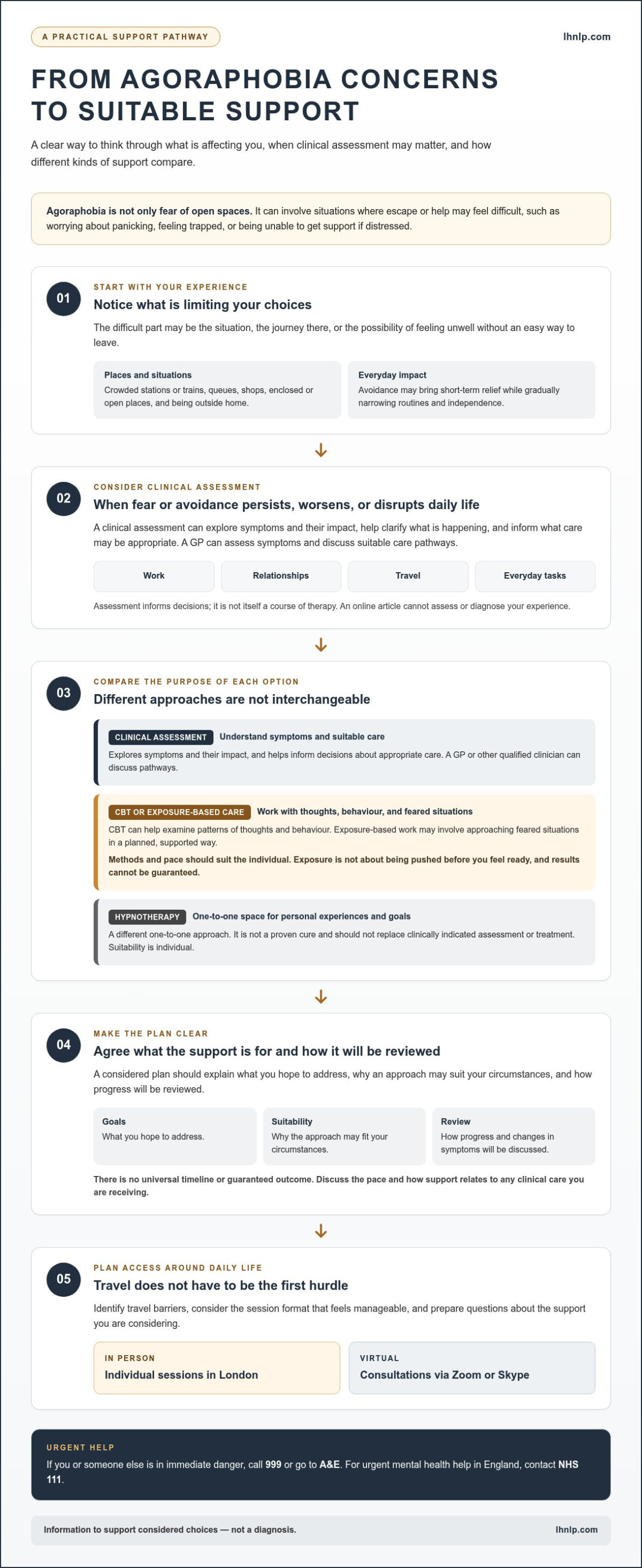
Agoraphobia is fear of situations where escape or help may feel difficult, not simply fear of open spaces. Someone may worry about panicking, feeling trapped, or being unable to get support if they become distressed. The Agoraphobia overview offers further background, but an online article can’t assess or diagnose your experience.
Which situations can agoraphobia make difficult?
A crowded station or busy train may be hardest for one person; another may struggle with queues, shops, enclosed places, open places, or being outside home. The concern may be the situation itself, the journey there, or the possibility of feeling unwell without an easy way to leave.
Avoidance can bring short-term relief, while gradually narrowing routines and independence. You might change your route to avoid a station, rely on someone else for errands, or stop travelling to parts of the city. These responses can be attempts to feel safe. If they’re limiting your choices, consider discussing the pattern with a qualified professional.
When is it time to seek support?
Consider a clinical assessment if fear or avoidance persists, worsens, or disrupts work, relationships, travel, or everyday tasks. A GP can assess your symptoms and discuss appropriate care pathways. Assessment may also help clarify what’s happening and whether other concerns are involved. You don’t have to wait until every part of daily life is affected before asking for help.
If you’re looking into fear of open spaces (agoraphobia) treatment London, remember that information and one-to-one support serve different purposes from clinical assessment. If you or someone else is in immediate danger, call 999 or go to A&E. For urgent mental health help in England, contact NHS 111. Seeking support is a considered first step, not a demand to tackle every feared situation at once.
Agoraphobia treatment options in London: understand the differences
Support options have different purposes, so it helps to distinguish clinical assessment from therapy and other one-to-one approaches. NHS information describes treatment options for agoraphobia, and CBT is a recommended approach for anxiety-related difficulties. The NHS overview of agoraphobia treatment is a useful place to learn about the condition and available care. The right option depends on your symptoms, circumstances, goals, and relevant clinical advice.
| Option | Main purpose | Scope to understand |
|---|---|---|
| Clinical assessment | Explore symptoms, their impact, and what kind of care may be appropriate. | It helps inform decisions; it isn’t itself a course of therapy. A GP or other qualified clinician can discuss suitable pathways. |
| CBT or exposure-based care | CBT can help people examine patterns of thoughts and behaviour. Exposure-based work may involve approaching feared situations in a planned, supported way. | Methods and pace should suit the individual. Exposure isn’t about being pushed into situations before you feel ready, and results can’t be guaranteed. |
| Hypnotherapy | One-to-one support that can provide space to explore personal experiences and goals. | It isn’t a proven cure or a substitute for clinically indicated assessment or treatment. Suitability is individual. |
How do CBT and exposure-based approaches differ from hypnotherapy?
CBT is a structured psychological therapy that works with links between thoughts, feelings, and behaviour. When exposure is used, a clinician may help someone approach feared situations gradually as part of a planned treatment. Hypnotherapy is a different one-to-one approach. It shouldn’t be presented as equivalent to CBT or as following a specific clinical protocol without evidence. If you’re weighing up fear of open spaces (agoraphobia) treatment London, discuss your care needs with an appropriate clinician, especially if symptoms significantly affect daily life.
What should a realistic treatment plan make clear?
A considered plan should explain what you hope to address, why an approach may suit your circumstances, and how you and the practitioner will review progress. Discuss the pace rather than assuming it. There’s no universal timeline or guaranteed outcome. Ask how the support relates to any clinical care you’re receiving and what to do if your symptoms change or worsen.
For an overview of the practice’s one-to-one phobia treatment support, read the relevant service information. Hypnotherapy sessions can make room for your experience and goals while remaining distinct from clinical diagnosis and care.
Hypnotherapy for Agoraphobia: Questions to Consider
Is hypnotherapy a guaranteed cure for agoraphobia? No. People’s needs and responses differ, and one-to-one hypnotherapy shouldn’t be presented as a proven cure or replacement for clinically indicated care. Before choosing support, consider your goals, the approach’s purpose and evidence, how comfortable you feel with it, and whether accessing sessions is manageable.
- Goals: What would you like support with, and can the approach address that aim?
- Evidence and scope: Is the option part of an established clinical treatment plan, or a different form of one-to-one support? The Mayo Clinic’s information on cognitive behavioural therapy outlines a recognised clinical approach to agoraphobia.
- Comfort and access: Do you feel at ease discussing your experience in this format? Would travelling to a session feel manageable, or would virtual support be easier to access?
What might make one-to-one hypnotherapy a useful support option?
A one-to-one session offers space to describe your experience, clarify what you hope to work towards, and consider whether this support feels suitable. At London Hypnotherapy & NLP, individual sessions last approximately 50 to 60 minutes and may involve hypnotherapy or NLP. Sessions are tailored to the person’s experience and goals, not a promise of symptom relief. You can read about the practitioner and practice background to learn more about the service.
Access matters, too. In-person sessions are available at Harley Street, Ealing, and Tokenhouse Yard. Virtual consultations via Zoom and Skype offer another format to consider if travel is difficult. Neither format guarantees an outcome; consider which setting feels more workable for you.
When should you seek clinical assessment first?
Prioritise assessment if symptoms are severe, worsening, broadly affecting daily life, or difficult to understand. A GP or another appropriate clinician can assess your needs and discuss relevant care. Hypnotherapy does not provide psychiatric diagnosis or medical prescriptions. If you already receive clinical care, discuss additional support in a coordinated way where appropriate. Don’t stop medication or change treatment without advice from the clinician responsible for your care.
For anyone weighing up fear of open spaces (agoraphobia) treatment London, match support to the person rather than expecting one approach to suit everyone. A practical next step is to clarify what you need, what each option can offer, and how progress and changing needs will be considered.
Planning agoraphobia support around London travel and daily life
Arranging support can raise practical questions if travel or leaving home feels difficult. An Underground journey, a busy station, or crossing the city may be a barrier for some people, though these aren’t universal triggers. Planning can make the first step more manageable without requiring you to tackle a difficult journey before you’re ready.
- 1. Identify the barriers. Note what makes attending feel difficult, such as a particular route, crowds, waiting, or uncertainty about how you’ll feel.
- 2. Choose a format. Consider whether an in-person appointment or a virtual consultation feels more manageable and appropriate for your circumstances.
- 3. Prepare questions. Write down what you’d like the practitioner to understand, what you hope to discuss, and anything you want to know about the session.
- 4. Agree a manageable next step. Focus on arranging or preparing for the appointment rather than setting yourself a travel challenge you don’t feel ready to take.
How can you prepare for a first appointment?
A few notes can help you make use of the time. You might record situations you’ve been avoiding, what concerns you about them, how this affects your daily routine, and what you’d like support to focus on. You don’t need to arrive with a perfect explanation. Individual sessions last approximately 50 to 60 minutes, giving time to discuss your experience and goals at a considered pace.
You don’t need to practise exposure or make yourself travel to a location as a condition of seeking support. If you’re already receiving clinical care, keep that in view as you plan and follow your clinician’s advice.
Could a virtual appointment make the first step easier?
In-person appointments are available at Harley Street, Ealing, and Tokenhouse Yard. If getting to a location feels like an extra hurdle, virtual consultations via Zoom or Skype provide another way to meet. Remote sessions may be convenient, but they won’t be the right format for everyone or equivalent in every clinical situation. Consider your needs, privacy, comfort with video calls, and any clinical advice when choosing.
If a virtual consultation feels like a practical place to begin, explore virtual hypnotherapy sessions and consider whether that format suits your circumstances. For fear of open spaces (agoraphobia) treatment London, the first step can be a conversation about support, not a journey across the city.
Starting agoraphobia treatment with London Hypnotherapy & NLP
Once you’ve considered the difference between clinical care and complementary one-to-one support, you can decide whether hypnotherapy or NLP is an option you’d like to explore. London Hypnotherapy & NLP offers individual sessions focused on your experience and goals. They aren’t psychiatric diagnosis, a guaranteed treatment, or a substitute for clinically indicated care. If you’re unsure what support you need, a GP or other appropriate clinician can help you consider that question.
What can you expect from an initial conversation?
You can share what has been concerning you, what you hope to work towards, and any questions about the session format. There’s no need to have everything organised in advance. One-to-one sessions last approximately 50 to 60 minutes, creating time to discuss your circumstances and aims. If you’re receiving clinical care, mention it so any additional support can be considered in that context.
For a clearer picture of the practice’s approach to phobia support, read the phobia treatment information. If you have practical questions about arranging a session, the practice contact page provides a way to make an enquiry.
How can you take a manageable next step?
Choose a format that feels practical for your circumstances. In-person appointments are available at Harley Street, Ealing, and Tokenhouse Yard. Virtual consultations via Zoom and Skype offer an alternative if travelling feels difficult or adds pressure. Neither format is right for everyone, so consider what feels manageable and any relevant clinical advice.
Exploring options doesn’t commit you to a particular approach or outcome. Take time to read, write down questions, and decide what feels appropriate. If you’re considering fear of open spaces (agoraphobia) treatment London, an enquiry can help you understand the available one-to-one support. You don’t have to feel ready for a journey before learning about your options.
When you feel ready, you can make a gentle enquiry about support and share what you’d like to know.
Choose a next step that feels manageable
Finding the right fear of open spaces (agoraphobia) treatment London begins with recognising what you’re experiencing and matching support to your needs. Clinical assessment can help clarify which care is appropriate. One-to-one hypnotherapy or NLP is a separate support option, not a diagnosis, guaranteed cure, or replacement for clinically indicated treatment.
Practical access matters, too. London Hypnotherapy & NLP offers individual sessions lasting approximately 50 to 60 minutes, with in-person appointments at Harley Street, Ealing, and Tokenhouse Yard, as well as virtual consultations via Zoom and Skype. Consider which format feels more workable without expecting yourself to solve every challenge at once.
If you’d like to understand the practice’s support for phobias, explore support for phobias and take a considered next step. You can begin by gathering information and deciding what feels right.
Frequently Asked Questions
Is agoraphobia just a fear of open spaces?
No. Agoraphobia isn’t simply a fear of open spaces; it involves fear of situations where escape may feel difficult or help unavailable if panic or distress occurs. These situations can include public transport, crowds, queues, shops, enclosed or open places, or being outside home. Experiences vary from person to person. A qualified clinician can assess whether what you’re experiencing may be agoraphobia or another concern.
Can hypnotherapy help with agoraphobia?
Hypnotherapy may be considered as individual support, but it isn’t a guaranteed cure and shouldn’t replace clinically indicated assessment or treatment. Whether it feels suitable depends on your needs, goals, and circumstances. A one-to-one session can offer space to discuss your experience and what you hope to address. If symptoms are severe, worsening, or significantly limiting daily life, speak with a GP or appropriate clinician about assessment and care options.
What is the recommended treatment for agoraphobia in the UK?
CBT is a recommended treatment for agoraphobia, and treatment may include planned work with feared situations, guided by an appropriate clinician. NICE guidance recommends CBT for panic disorder with or without agoraphobia. A GP or NHS Talking Therapies service can help discuss suitable care. In England, adults can self-refer to NHS Talking Therapies for anxiety and depression, though the right pathway depends on individual circumstances.
Can I have agoraphobia treatment online in London?
Yes. London Hypnotherapy & NLP offers virtual consultations via Zoom and Skype, as well as in-person appointments. If you’re seeking fear of open spaces (agoraphobia) treatment London, an online session may reduce the travel involved in accessing one-to-one hypnotherapy or NLP support. Remote appointments won’t suit everyone or every clinical situation, so consider your circumstances and any advice from a clinician when choosing a format.
How do I know if I should speak to a GP about agoraphobia?
Consider speaking to a GP if fear or avoidance persists, worsens, or disrupts everyday activities such as work, travel, or errands. You can describe the situations that feel difficult, how often this happens, and its impact on your routine. A GP can assess your symptoms and discuss care pathways. If you’re in immediate danger, call 999 or go to A&E; for urgent mental health help in England, contact NHS 111.
How long does agoraphobia treatment take?
There’s no fixed timeline or number of sessions that applies to everyone. Duration depends on the person’s needs, the type of support, and how care is reviewed over time. At London Hypnotherapy & NLP, individual one-to-one sessions last approximately 50 to 60 minutes; that’s the length of a session, not a promise about the overall course. Discuss goals and progress with the relevant practitioner or clinician.
Where can I attend an in-person hypnotherapy session in London?
London Hypnotherapy & NLP offers in-person appointments at Harley Street, Ealing, and Tokenhouse Yard. Individual sessions last approximately 50 to 60 minutes and provide one-to-one space to discuss your experience and goals. If travelling to an appointment feels difficult, virtual consultations via Zoom and Skype are also available. Hypnotherapy is support, not psychiatric diagnosis or a substitute for clinically indicated care.