

Imagine standing on a crowded platform at Oxford Circus, watching the Tube doors slide shut while your heart hammers against your ribs; it’s a silent alarm screaming that the space is too small and the air too thin. It’s a heavy burden to carry, especially in a city that requires us to descend into tunnels or ascend to high-rise offices. If you’ve found yourself avoiding social events or dreading medical procedures like MRI scans, exploring hypnotherapy for claustrophobia London can be the first step toward a life without these self-imposed borders.
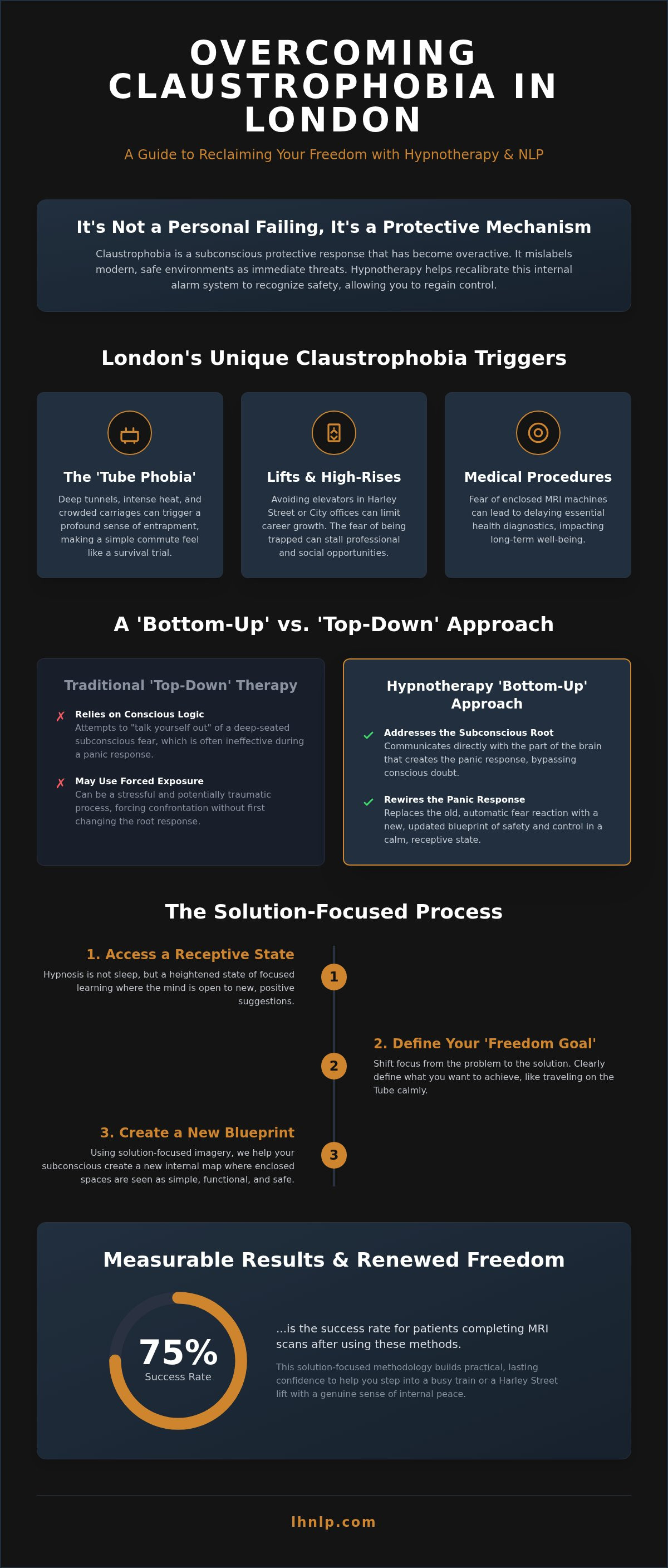
You likely already know that your fear isn’t a lack of willpower. It’s a protective response from your subconscious that has simply become overactive. With a 75% success rate for patients completing MRI scans through these methods, the evidence for change is compelling. Through a solution-focused approach, you can learn to travel the Underground without constantly scanning for the next exit. This article explores how the integration of NLP and hypnotherapy helps you regain control, allowing you to step into a Harley Street lift or a busy train with a genuine, lasting sense of internal peace.
Key Takeaways
- Understand that claustrophobia is not a personal failing but a subconscious protective mechanism that can be recalibrated to recognize safety in modern environments.
- Discover how specialized hypnotherapy for claustrophobia london helps you navigate unique urban triggers, from the deep tunnels of the Tube to the elevators of Harley Street, with quiet composure.
- Explore the differences between traditional therapies and the “bottom-up” approach of hypnotherapy, which addresses the root of the panic response without the trauma of forced exposure.
- Learn how to define a clear “Freedom Goal,” allowing you to shift your mental focus from the limitations of the past toward a future of effortless movement.
- Gain insight into a solution-focused methodology that prioritizes your desired outcomes, ensuring each session builds practical, lasting confidence in enclosed spaces.
Understanding Claustrophobia in the Context of London Life
For many living in the capital, the world doesn’t feel like a sprawling metropolis of opportunity; it feels like a series of narrow corridors and closing doors. This experience is often rooted in a subconscious protective mechanism that has simply gone into overdrive. Your mind, in its infinite desire to keep you safe, has mislabeled modern environments as immediate threats. A foundational step in moving forward involves Understanding Claustrophobia as a learned response rather than a permanent flaw in your character. By choosing hypnotherapy for claustrophobia london, you can begin the process of teaching your subconscious that you are, in fact, secure.
The cost of avoidance in a city like ours is steep. It starts with small detours and eventually leads to a life that feels significantly smaller than it should be. You might find yourself checking the floor plan of a restaurant before agreeing to a dinner date or walking up ten flights of stairs to avoid a lift in a City office. These aren’t just inconveniences. They are moments where your freedom is traded for a temporary, fragile sense of safety. It’s estimated that 10% of the UK population is affected by this phobia at some point, so you are far from alone in this struggle.
The ‘Tube Phobia’ Phenomenon
The London Underground presents a unique set of triggers that few other environments can match. It’s the combination of deep level tunnels, the intense heat of the Northern Line, and the physical proximity of crowds that can make a simple commute feel like a survival trial. When a train stops between stations, the lack of an immediate exit can trigger a profound sense of entrapment. Tube phobia is a specific manifestation of spatial anxiety in urban environments where the perceived inability to escape triggers a fight or flight response. This reaction is visceral, but it is also something that can be recalibrated through professional intervention.
When the City Becomes Too Small
Claustrophobia often casts a long shadow over professional and social lives in London. Career growth can stall when you feel unable to attend meetings in windowless boardrooms or accept a promotion that requires working on the upper floors of a skyscraper. Even historic London venues, with their charming but narrow stairwells and cramped seating, become places of dread rather than delight. Perhaps most critically, this fear can impact your health. Many Londoners delay essential medical procedures, such as MRI scans, because the thought of the machine is too much to bear. However, the mind is plastic and capable of change. You don’t have to live a life dictated by the size of the room you’re in.
How Hypnotherapy for Claustrophobia Works
At the heart of every claustrophobic reaction lies the amygdala, a small, almond-shaped part of the brain responsible for our survival. When you step into a crowded Tube carriage, this biological alarm system misinterprets the enclosed space as a life-threatening trap, flooding your system with adrenaline. While NHS information on claustrophobia provides a vital medical perspective on these symptoms, understanding the mechanics of the mind allows us to intervene directly at the source. Through hypnotherapy for claustrophobia london, we don’t just manage the symptoms; we communicate with the part of the brain that creates them.
The hypnotic state is essentially a heightened state of learning where the conscious mind, with all its logic and doubt, steps aside. This allows the subconscious to become receptive to new, calmer perspectives. It’s a process of internal rewiring. We replace the old, automatic panic response with a fresh sense of space and safety. This change isn’t forced; it’s a methodical transition from feeling trapped to feeling in control.
Accessing the Subconscious Blueprint
You’ve likely tried to “talk yourself out” of a panic attack before. Willpower alone often fails because it operates in the conscious mind, while the phobia is rooted deep in the subconscious blueprint. Hypnosis bypasses what we call the ‘critical faculty’, the mental gatekeeper that keeps old habits in place. By accessing this deeper level, we use solution-focused imagery to create a new internal map. Instead of seeing a lift as a cage, your mind begins to see it as a simple, functional tool for movement. If you’re ready to start this journey, you can contact Kamalyn Kaur to discuss how these sessions can support your specific goals.
The Synergy of Hypnosis and NLP
Neuro-Linguistic Programming (NLP) acts as a powerful catalyst when combined with clinical hypnosis. Techniques like ‘The Movie Screen’ allow you to view your triggers from a safe, detached distance, effectively desensitizing the emotional charge. This synergy is a hallmark of professional phobia treatment, providing several distinct advantages:
- Rapid Desensitization: NLP tools work quickly to disrupt the old neural pathways of fear.
- Active Empowerment: You learn techniques to manage your state in real-time, even outside the session.
- Subconscious Alignment: Hypnosis ensures these new tools are integrated at the deepest level of your mind.
This dual-layered approach ensures that the changes you experience aren’t just temporary relief but a fundamental shift in how you perceive the world around you. Hypnotherapy for claustrophobia london offers a structured path back to your freedom of movement, allowing you to navigate the city with a quiet, inner confidence.
Hypnotherapy vs. Traditional Phobia Treatments
Choosing the right path for recovery often involves a choice between enduring a long, clinical process or seeking a more targeted intervention. Conventional methods like Cognitive Behavioural Therapy (CBT) generally work from the ‘top-down’, using logic and reasoning to challenge the irrational thoughts that arise during a panic attack. While valuable, this approach requires the conscious mind to fight a battle against a subconscious that is already in a state of high alert. In contrast, hypnotherapy for claustrophobia london utilizes a ‘bottom-up’ methodology. It speaks directly to the nervous system, calming the physical response before the mind even has a chance to spiral into ‘what if’ scenarios.
Traditional exposure therapy, which involves gradually facing the feared environment, can sometimes be traumatizing if the person feels they have no ‘off’ switch. Without proper subconscious preparation, being forced to stay in a small room can reinforce the very panic we’re trying to dissolve. Hypnotherapy offers a safer alternative by allowing for mental rehearsals in a state of profound relaxation. We address the root cause only if it’s necessary for your progress, but our primary focus remains on the solution. You don’t always need to spend months digging into the past to build a better future. If you can learn how to respond differently today, the ‘why’ of yesterday becomes less relevant.
Why Speed Matters for Londoners
Life in the City doesn’t often allow for lengthy recovery periods. Whether it’s a promotion that requires frequent travel to high-rise offices or a social life that revolves around the West End, the practical need for rapid relief is significant. Hypnotherapy is widely regarded as a high-efficiency intervention, often requiring only 2 to 4 sessions to achieve a lasting shift. By working with an experienced London NLP practitioner, you can fast-track this change. We focus on practical, real-world results that allow you to return to your commute and your career without the heavy weight of spatial anxiety holding you back.
Safety and Control in the Chair
A common hesitation regarding hypnosis is the fear of losing control. It’s a persistent myth fueled by stage performances, but clinical hypnotherapy is a vastly different experience. You are always in charge. The therapist acts as a skilled guide, helping you navigate your own internal landscape, but you remain the one behind the wheel. You cannot be made to do or say anything that goes against your values. In fact, most people find the experience empowering because they finally regain the control that the phobia had previously taken away. You’re not handing over your mind; you’re simply learning how to use it more effectively.
Preparing for Your Session: From Anxiety to Action
The journey toward reclaiming your freedom starts long before you sit in the therapist’s chair. It begins with a conscious decision to stop managing your fear and start resolving it. When you prepare for hypnotherapy for claustrophobia london, you’re not just preparing for a session; you’re setting the stage for a fundamental shift in how you interact with the city. This process is methodical and supportive, designed to move you from a state of hyper-vigilance to one of quiet confidence. To make the most of this transition, it’s helpful to approach the work with a clear internal structure.
- Step 1: Identify Specific Triggers. Does your anxiety peak in the high-speed lifts of a City skyscraper, or is it the specific crowdedness of the Northern Line? Understanding these nuances helps us tailor the subconscious suggestions.
- Step 2: Define Your ‘Freedom Goal’. Focus on what you will do once the fear is gone. Perhaps it’s attending a gallery opening in a basement venue or finally taking that promotion that requires frequent travel.
- Step 3: Choose Your Environment. Decide whether you feel more secure in a clinical setting or within the comfort of your own home.
- Step 4: Build Rapport. The initial consultation is vital for establishing trust, ensuring you feel safe enough to let go of old patterns.
- Step 5: Engage with the Process. During the session, you’ll enter a light trance where your mind becomes a workshop for new, spatial perspectives.
Harley Street or Home? Choosing Your Setting
For many, visiting a dedicated Harley Street hypnotherapy clinic provides a powerful sense of professional focus and clinical excellence. Stepping into a space dedicated to healing can act as a psychological anchor for change. However, if your phobia currently makes traveling into Central London feel impossible, online hypnotherapy serves as a vital and effective alternative. Virtual sessions follow the same rigorous clinical principles as in-person visits, allowing you to begin the ‘rewiring’ process in an environment where you already feel safe. This flexibility ensures that your recovery isn’t delayed by the very symptoms you’re trying to treat.
What Does the Change Feel Like?
Change often arrives not as a sudden explosion of courage, but as a gradual fading of the old panic response. You might find yourself standing in a lift or sitting on a train and suddenly realizing that you haven’t checked for the nearest exit. The terrifying ‘what if’ thoughts are replaced by a sense of neutrality. Clients often report a sense of quiet indifference toward spaces that previously triggered an immediate alarm response. It’s a profound feeling of being ‘back in your own skin’, where the walls of the city no longer feel like they’re closing in. If you’re ready to experience this shift for yourself, you can book your initial consultation and take the first step toward a more expansive life.
The London Hypnotherapy & NLP Approach to Claustrophobia
At London Hypnotherapy & NLP, the methodology led by Kamalyn Kaur is built upon a foundation of deep empathy and clinical precision. We understand that your experience of claustrophobia is unique, even if the physical sensations of panic feel universal. By choosing hypnotherapy for claustrophobia london, you’re partnering with a practitioner who brings over 20 years of experience to your recovery. This isn’t a one-size-fits-all treatment; it’s a collaborative process where your internal world is respected and your capacity for change is the primary focus. We don’t just look at the mechanics of the phobia; we look at the person behind the fear, ensuring that the work we do resonates with your specific values and lifestyle.
Our approach is fundamentally solution-focused. While it can be helpful to understand where a fear began, we believe that your time is better spent focusing on where you want to go. We prioritize the ‘how’ of your freedom over the ‘why’ of your past limitations. This means each session is designed to move you closer to your Freedom Goal, whether that’s commuting on the Central Line with ease or attending a high-profile meeting in a City skyscraper. We offer sessions across London to ensure professional care is accessible, with clinical locations in Harley Street, Ealing, and Tokenhouse Yard in the City.
Tailored Sessions for London Professionals
The demands of a career in the capital often require us to operate in high-pressure, enclosed environments. From windowless boardrooms to the intense proximity of a rush-hour commute, the city can be a challenging landscape for those with spatial anxiety. We adapt our techniques to support the specific needs of London professionals, integrating advanced stress management tools that provide long-term calm beyond the therapy room. For those seeking to understand the wider applications of these methods, our hypnotherapy London guide offers a comprehensive look at how clinical hypnosis and NLP can transform your daily experience of urban life.
Your Path to Freedom Starts Here
Taking the first step is often the most difficult part of the journey, but it’s a step you don’t have to take alone. We offer a 15-minute discovery call to discuss your goals and ensure you feel completely comfortable with our approach before booking your first session. This conversation is an opportunity to ask questions and begin building the rapport that is so essential for deep subconscious work. Whether you choose to meet us in the West End, the City, or West London, the objective remains the same: reclaiming the city you love. You’ve spent enough time letting your world shrink; it’s time to let it expand again. Your freedom of movement is waiting, and the process of hypnotherapy for claustrophobia london is the bridge that carries you there.
Step Into a Larger World
The walls of the city don’t have to feel like they’re closing in on you. We’ve seen that claustrophobia is simply a protective mechanism that has lost its sense of proportion, and it can be recalibrated through a methodical, empathetic process. By integrating the depth of clinical hypnosis with the rapid change tools of Neuro-Linguistic Programming, you can shift your internal landscape from a state of restriction to one of expansive freedom. Whether your goal is to travel the Northern Line without a second thought or to use the lifts in your office with calm composure, this change is entirely possible.
Kamalyn Kaur brings over 20 years of clinical experience to every session, offering a solution-focused path that respects your pace and your history. With expertise in both hypnotherapy and NLP, the focus remains on your desired future rather than your past anxieties. Professional care is available at our convenient locations in Harley Street, the City, and Ealing, or through virtual sessions if you aren’t yet ready to travel. You can Book your consultation for claustrophobia relief in London today to discover how hypnotherapy for claustrophobia london can help you breathe easier in every space. Your world is waiting to grow larger again; let’s take that first step together.
Frequently Asked Questions
Is hypnotherapy for claustrophobia safe?
Hypnotherapy is a completely safe, non-invasive process that utilizes your mind’s natural ability to enter a state of focused relaxation. You remain in full control throughout the session; you aren’t asleep and cannot be made to do anything against your will. It’s simply a way of calming the nervous system so your subconscious can learn that you’re secure in environments it previously perceived as dangerous.
How many sessions will I need to see results?
Most clients experience a significant shift in their comfort levels within 2 to 4 sessions. While everyone’s journey is unique, the combination of NLP and hypnotherapy for claustrophobia london is designed for efficiency. This solution-focused approach aims to provide you with the tools for lasting change in a relatively short timeframe, allowing you to return to your normal routine with renewed confidence.
Can hypnotherapy help me prepare for an MRI scan in London?
Yes, hypnotherapy is highly effective for medical-related spatial anxiety, with research showing a success rate of around 75% for patients completing their scans. By mentally rehearsing the procedure in a state of deep calm, we can desensitize the triggers associated with the machine. This allows you to undergo necessary medical checks at Harley Street or other London clinics without the need for sedation or intense distress.
Will I be forced to go into a small space during the session?
No, you’ll never be forced into a physical space that makes you uncomfortable during our work together. Unlike traditional exposure therapy, which can sometimes feel overwhelming, we use mental rehearsal and desensitization techniques while you’re in a relaxed state. This allows your brain to process the environment as safe before you ever choose to step into a lift or a Tube carriage in the real world.
What if I can’t be hypnotized?
Almost everyone has the capacity to enter a hypnotic state because it’s a natural phenomenon we experience every day, such as when we lose track of time while reading or driving. Hypnosis isn’t something that’s done to you; it’s a collaborative state of receptivity. Even if you feel you’re too analytical, the integration of NLP techniques ensures the session remains effective by working with your conscious thought patterns as well.
Is virtual hypnotherapy as effective as in-person sessions for phobias?
Virtual sessions are just as effective as in-person appointments and are often preferred by those whose phobia makes traveling currently difficult. Working from the comfort of your own home can actually enhance the process, as you’re already in an environment where your nervous system feels safe. We use the same clinical principles and NLP tools via Zoom to achieve the same lasting results as we do in our Harley Street or Ealing offices.
How much does a hypnotherapy session in London cost?
The cost of sessions in the capital varies depending on the practitioner’s level of experience, their specialized expertise, and the location of the clinic. While price is a factor, it’s vital to choose a therapist who’s a member of a reputable professional body, such as the National Council for Hypnotherapy. Investing in a specialist with decades of experience often leads to faster, more sustainable results, potentially reducing the total number of sessions required.