

What if the persistent struggle to quit isn’t a failure of your character, but a natural result of a subconscious mind that’s still trying to protect you? You’ve likely felt that surge of stop smoking motivation on a Monday morning, only to watch it dissolve by Friday evening when the weight of the week settles in. It’s a common cycle where the fear of losing your emotional “crutch” outweighs the logical desire for health; creating a painful friction between who you are and who you want to be. This internal conflict is why willpower alone feels so fragile when faced with a familiar trigger.
In this guide, you’ll discover how to move beyond the exhausting reliance on fleeting willpower to align your inner narrative for a permanent, smoke-free life. We’ll examine the psychological roots of the habit, look at the shifting landscape of 2026 where the average pack now costs over ten dollars, and explain how you can finally achieve mental clarity without the constant shadow of a craving. It’s time to stop fighting your own mind and start understanding the mechanics of your freedom, allowing you to reclaim both your health and your peace of spirit.
Key Takeaways
- Understand why willpower is a finite resource and how to create lasting change by aligning your conscious health goals with your subconscious mind’s deeper needs.
- Discover the critical psychological victories that occur alongside physical milestones, helping you build momentum from the very first hour of your smoke-free journey.
- Explore how to use Neuro-Linguistic Programming techniques to shift your internal identity, moving beyond the fear of losing a “crutch” toward a sense of genuine liberation.
- Gain access to a practical five-step framework and the “4 Ds” method designed to protect and sustain your stop smoking motivation during unexpected moments of stress.
- Learn how professional hypnotherapy and NLP coaching can bridge the gap to a permanent smoke-free life by addressing the habit at its psychological root.
The Psychology of Stop Smoking Motivation: Why Willpower Fails
True stop smoking motivation isn’t a fleeting feeling or a sudden burst of energy that arrives on New Year’s Day. Instead, it’s a profound state of internal alignment where your conscious desires and your subconscious beliefs finally move in the same direction. Many people fail not because they lack strength, but because they’re caught in a “Conflict of Parts.” Your conscious mind understands the logic of health and the rising costs of cigarettes in 2026, yet your subconscious mind clings to the habit because it mistakenly believes the cigarette is providing a vital service. Intrinsic motivation is a self-sustaining flame fueled by personal conviction, whereas extrinsic pressure is a temporary spark ignited by outside demands or social guilt.
To succeed, you must identify the “secondary gains” that your mind associates with smoking. These are the hidden benefits, such as a perceived sense of stress relief, a moment of solitude, or a way to signal the end of a work task. When your subconscious thinks smoking is a protective tool, it will fight your attempts to quit. Understanding The Psychology of Stop Smoking Motivation requires looking beneath the surface of the habit to resolve these internal contradictions.
To better understand the mechanics of staying focused during this process, watch this helpful video:
Conscious Willpower vs. Subconscious Habit
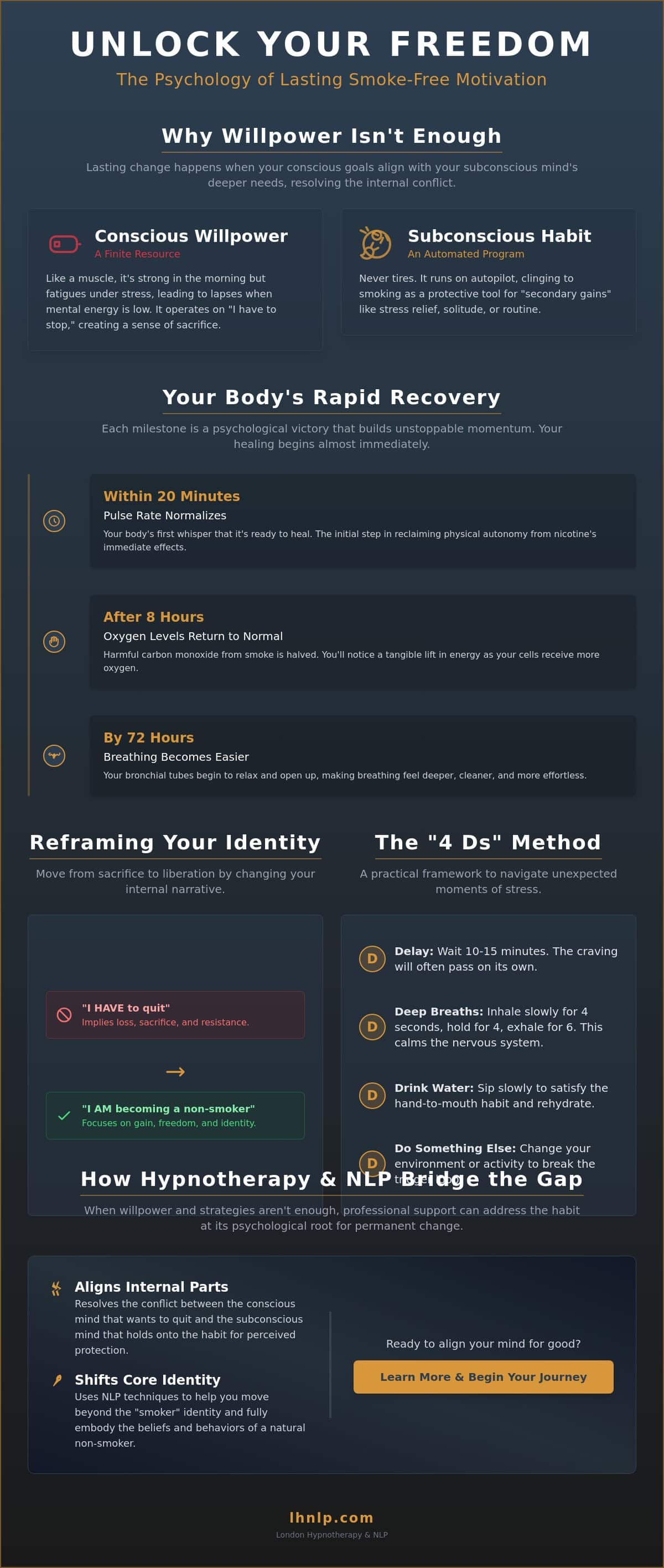
Think of your willpower as a muscle. It’s strong in the morning, but it fatigues by the end of a long, stressful day. This is why most lapses happen in the evening when your mental energy is depleted. Your subconscious, however, never tires. It operates on autopilot, protecting what it perceives as a “safety” habit. Through NLP coaching, we can identify these contradictions. We look for the moment where the “muscle” of willpower gives out and replace that struggle with a subconscious shift that makes smoking feel unnecessary rather than forbidden.
Moving from “Have to” to “Want to”
The language you use creates your reality. When you say “I must quit” or “I have to stop,” you’re inadvertently creating internal resistance. These phrases imply a sacrifice or a loss of freedom. True stop smoking motivation comes from reframing the narrative to focus on what you’re gaining: breath, vitality, and financial independence. By identifying your “Deep Why”, which is the core value like being present for your children or reclaiming your autonomy, you make the choice to be smoke-free non-negotiable. It’s no longer about what you’re giving up; it’s about the person you’re finally becoming.
The Motivation Timeline: What Happens When You Quit in 2026
The journey toward a smoke-free life isn’t a single event; it’s a sequence of physiological and psychological triumphs that build upon one another. If you’ve struggled before, it’s often because the focus remained solely on the physical discomfort, ignoring the profound mental shifts that occur simultaneously. By understanding this timeline, you can transform your stop smoking motivation from a desperate hope into a structured, predictable roadmap for success. The first victory happens faster than many realize. Within just 20 minutes of your last cigarette, your pulse rate begins to settle, returning to a more natural rhythm. This immediate response is the body’s way of whispering that it’s ready to heal. It’s a small, quiet moment, but it represents the first step in reclaiming your autonomy.
Physical Milestones: The Body’s Rapid Recovery
As you progress, the body’s rapid recovery provides the physical foundation for your mental resolve. After eight hours, carbon monoxide levels in your blood drop and oxygen levels return to normal, which often results in a noticeable lift in energy. By the 72-hour mark, your bronchial tubes begin to relax, making breathing feel deeper and more effortless. These aren’t just medical facts; they’re tangible proofs of your progress. Long-term commitment yields even deeper rewards. For instance, after one year, your risk of heart disease is halved compared to a smoker, and after ten years, your risk of lung cancer is also reduced by approximately 50 percent. Every breath becomes a testament to your choice.
Psychological Milestones: Reclaiming Your Mental Freedom
While the body heals, the mind undergoes its own evolution. The 48-hour mark is often the peak of nicotine withdrawal, requiring a significant mental shift to view the discomfort not as a threat, but as the sensation of the habit leaving your system. Week one is dedicated to breaking the “hand-to-mouth” ritual. This is where you learn to find new anchors for your hands and your time, replacing old cues with conscious choices. If you find the mental hurdles of this timeline daunting, exploring specialised support can help you navigate these transitions with greater ease and internal peace.
By month three, you’ll likely notice a beautiful transition: cravings are no longer a constant, nagging thought. They become occasional whispers that you can easily dismiss. The most profound shift, however, occurs at the one-year milestone. This is the point where the identity of “ex-smoker” begins to fade away, replaced by the quiet confidence of someone who simply doesn’t smoke. You’re no longer “quitting”; you’ve arrived. This identity shift is the ultimate fuel for long-term stop smoking motivation, ensuring that your daily life is no longer defined by what you’ve left behind, but by the absolute freedom you’ve gained.
Reframing Your Identity: From Smoker to Non-Smoker
Many individuals embarking on this path feel a quiet, heavy sense of grief. It’s as if they’re saying goodbye to an old friend who was present through every break-up, every deadline, and every celebration. This feeling of loss is genuine and shouldn’t be dismissed, yet it’s based on a psychological illusion that needs to be gently unraveled. The cigarette wasn’t your friend; it was the thief that stole your breath, your finances, and your peace of mind. When your stop smoking motivation is built on a foundation of perceived sacrifice, it will always feel fragile. Instead, we must shift the focus toward the profound liberation of indifference. A non-smoker doesn’t spend their day resisting a cigarette; they simply don’t want one.
To reach this state, you have to change the internal “movie” you play about smoking. If your subconscious still views the habit as a reward or a secret escape, you’ll constantly feel deprived. By shifting your identity at a core level, you stop being a “smoker who is trying to quit” and become a person who is simply free from tobacco. This isn’t a battle of will. It’s a process of reclaiming your original, non-smoking self, allowing you to move through the world without the constant, nagging weight of a dependency that no longer serves the person you’ve become in 2026.
The NLP “Swish” Pattern for Habit Change
NLP techniques offer a practical way to edit the mental imagery that drives your cravings. The “Swish” pattern works by taking the vivid, attractive image your mind has created of smoking and rapidly replacing it with a more powerful, vibrant image of your healthy, future self. You begin to notice the reality of the habit, the stale smell on your clothes and the bitter taste on your tongue, rather than the romanticised version your subconscious has stored. This method weakens the old urge and strengthens your new identity. By training your mind to “swish” away the old cue, you make the healthy choice your new default response.
Social London: Navigating Triggers
Navigating the social landscape of London can be particularly challenging when you’re in the early stages of change. Whether it’s the pub garden in Soho or the high-pressure work breaks in the City, the environment is saturated with old cues. However, you aren’t an outsider looking in; you’re the person who has found the exit. Staying calm in these high-stress urban environments requires a shift in perspective. You aren’t missing out on a break; you’re finally enjoying one without the interruption of a chemical need. For those who want to deepen this transition, Stop Smoking Hypnotherapy in London offers a path to resolve these environmental triggers at a subconscious level. By changing how you perceive these social anchors, you can remain present and relaxed, knowing that your freedom is far more valuable than a momentary habit.
Practical Strategies to Sustain Your Quit Smoking Motivation
Maintaining your stop smoking motivation requires more than just a strong start; it demands a practical toolkit for those specific moments when your resolve feels thin. Cravings are not permanent states of being. They are physiological waves that peak and then inevitably recede, usually lasting no more than five to ten minutes. When you feel that familiar tug, remember the “4 Ds” of craving management. You must Delay the action, Deep breathe to calm your nervous system, Drink water to create a physical shift, and Do something else to redirect your focus. These simple actions act as a circuit breaker, preventing a momentary impulse from becoming a permanent decision.
If you do experience a “slip” and have a cigarette, it’s vital to avoid the trap of “all-or-nothing” thinking. One cigarette doesn’t erase the hours or days of success you’ve already achieved. Instead of viewing it as a failure, treat it as a valuable data point. What was the trigger? What was your internal dialogue at that moment? By approaching the situation with curiosity rather than shame, you preserve your motivation and can immediately return to your smoke-free path. Shame is a heavy weight that prevents progress; curiosity is a light that shows the way forward.
The 5-Minute Craving Survival Guide
When a crisis of motivation hits, use this framework to navigate the storm. First, recognise the craving as a transient physical sensation, much like an itch that will eventually fade, rather than a command that must be followed. Second, use a “pattern interrupt” by doing something completely unexpected. If you’re sitting down, stand up and stretch. If you’re in the kitchen, move to a different room. This breaks the neurological loop of the habit. Third, breathe deeply into your diaphragm. This physiological shift signals to your brain that you are safe, lowering the cortisol spike that often accompanies a craving. Fourth, remind yourself of your “Deep Why.” Finally, celebrate the moment the craving passes as a tangible victory for your subconscious mind.
Visualising the Financial and Personal Gain
The financial impact of smoking in a city like London is significant. With the average cost of cigarettes continuing to rise in 2026, a pack-a-day habit represents a substantial portion of your annual income that could be redirected toward your true passions. Imagine what that budget could provide instead: a luxury holiday, a significant contribution to a home deposit, or the freedom to pursue a long-held dream. Setting a “Reward Goal” that feels tangible and exciting provides a positive focus for your mind. Rather than thinking about what you are losing, you are constantly reminded of what you are building. For those seeking a deeper transformation, Hypnotherapy London provides the professional tools to align your financial goals with your subconscious desires. If you’re ready to make this change permanent, contact us today to begin your journey.
Professional Support: How Hypnotherapy and NLP Bridge the Gap
While the strategies we’ve explored provide a robust framework for daily management, many individuals find that the deepest roots of their habit require a more specialised intervention. Professional support isn’t an admission of weakness; it’s a strategic decision to bypass the limitations of the conscious mind. By working with a practitioner, you can transform your stop smoking motivation from a daily effort into a permanent state of being. This approach targets the subconscious mechanisms that keep the habit alive, effectively removing the internal friction that leads to willpower fatigue. It’s the difference between fighting a tide and simply stepping out of the water.
Hypnotherapy acts as the bridge between your logical desire for health and your subconscious need for security. It’s the tool that makes your resolve permanent by addressing the “Conflict of Parts” at its source. When the subconscious mind finally understands that the cigarette is no longer providing a benefit, the struggle simply vanishes. You’re no longer “trying” to be a non-smoker; you’ve arrived at a place where the habit no longer has a place in your narrative. This internal resolution is what allows for a life of genuine freedom and clarity in 2026.
Kamalyn Kaur’s Approach to Smoking Cessation
Kamalyn Kaur’s clinical approach in London is designed to address these psychological layers methodically. By combining the precision of NLP coaching with the profound depth of clinical hypnotherapy, she helps clients dismantle the subconscious associations we’ve discussed. Whether you attend a personalised session in Harley Street, Ealing, or Tokenhouse Yard, the focus remains entirely on your unique triggers and mental landscape. For those with demanding schedules or who reside outside the capital, Online Hypnotherapy Services provide the same level of professional, empathetic guidance from the comfort of your own environment. This two-pronged attack ensures that both the conscious habit and the subconscious root are resolved simultaneously.
What to Expect from Your Sessions
A typical session is a safe, relaxing, and deeply restorative experience. You’ll work to break the “trance” of the smoker, which is that automatic, unthinking loop that leads you to reach for a cigarette. By installing new, healthier responses to old stress triggers, you build an unshakeable confidence in your ability to remain smoke-free for life. The process doesn’t just remove a habit; it mobilises your inner resources, helping you reclaim a sense of control that may have felt lost for years. If you’re ready to move beyond fleeting willpower and embrace a permanent change, the next step is to book a consultation through the London Hypnotherapy & NLP Contact page. Your journey toward mental freedom and long-term health is a process that can be methodically achieved with the right partner by your side.
Reclaim Your Freedom and Breathe Again
The journey toward a smoke-free life isn’t a test of sheer strength, but a process of profound psychological realignment. We’ve explored how true stop smoking motivation arises when you resolve the deep-seated conflict between your conscious health goals and subconscious habits. By shifting your identity from a smoker to a non-smoker and utilizing practical tools like the 4 Ds, you move from a state of perceived deprivation to one of genuine liberation. You’ve seen the timeline of recovery and understood that professional intervention can bridge the gap where willpower often falters, especially in the high-pressure environment of 2026.
If you’re ready to make this change permanent, expert guidance is available to help you navigate the mental landscape of quitting. Led by Kamalyn Kaur, a clinical hypnotherapy and NLP specialist with over 20 years of experience, our personalised sessions target the subconscious root of your habit. With convenient locations in Harley Street and Ealing, we offer a solution-focused approach designed for your specific needs. Book your professional quit smoking session in London today and begin the next chapter of your life with clarity and confidence. Your future self is waiting for you to take this final, decisive step toward lasting health.
Frequently Asked Questions
How can I motivate myself to stop smoking when I enjoy it?
You can find lasting motivation by understanding that the “enjoyment” you feel is often just the relief of satisfying a chemical craving rather than a genuine pleasure. By identifying the specific emotional needs smoking seems to meet, such as stress relief or a moment of peace, you can find more fulfilling ways to satisfy them. This shift in perspective helps build a more sustainable stop smoking motivation that doesn’t feel like a sacrifice or a loss of a friend.
Is it possible to quit smoking without using willpower?
It’s entirely possible to quit without relying on the exhausting and finite resource of willpower. When you align your subconscious beliefs with your conscious desires through methods like hypnotherapy or NLP, the urge to smoke simply dissolves. This internal harmony means you aren’t fighting yourself every day, making the transition feel natural and permanent rather than a constant struggle against your own mind.
How long does it take for stop smoking motivation to become a permanent habit?
While physical cravings often subside within a few days, the psychological identity shift typically takes between 21 and 66 days to feel fully integrated into your daily life. By the one-year mark in your journey, most people find that their stop smoking motivation has evolved into a quiet, permanent state of being. At this stage, you no longer think of yourself as someone who is “trying to quit,” but as a person who simply doesn’t smoke.
Can hypnotherapy help if I have failed to quit smoking many times before?
Past failures are often the best indicators that you were relying on willpower alone rather than addressing the subconscious root of the habit. Hypnotherapy is particularly effective for those who have tried and failed before because it bypasses the conscious resistance that kept you stuck. It allows you to rewrite the internal script that previously led to a lapse, turning past mistakes into valuable data for your final success.
What is the most effective way to handle smoking triggers in a busy city like London?
The most effective way to manage triggers in London is to use a “pattern interrupt” to break the automatic association between a specific environment and a cigarette. Whether you’re in a crowded pub garden or navigating a stressful commute, shifting your physical state or your internal focus can stop the trigger in its tracks. Viewing these moments as opportunities to practice your new freedom changes the dynamic from one of fear to one of empowerment.
Does stop smoking hypnosis work for everyone?
Hypnosis is a highly effective tool for anyone who is genuinely open to the process and ready for a meaningful change in their life. It isn’t a form of mind control, but a collaborative partnership between you and the practitioner. If you have a clear “Deep Why” and a willingness to engage with your subconscious mind, the method can be a transformative way to achieve your goals.
How many sessions of hypnotherapy are usually needed to stop smoking?
Most individuals experience a significant and lasting shift within one to two intensive sessions, though the exact number depends on your history and the complexity of your triggers. These sessions are designed to be thorough and solution-focused, ensuring that the subconscious foundations of the habit are fully addressed. The focus is always on providing you with the tools for a permanent, self-sustaining change without the need for long-term intervention.
What happens if I lose my motivation after a few weeks of being smoke-free?
If your motivation dips, it’s usually a sign that your conscious focus has drifted away from your core values and toward a temporary stressor. Reconnecting with your “Deep Why” and using practical tools like deep breathing or the “4 Ds” can help you navigate these temporary lulls. Remember that motivation is a rhythmic state that you can consciously choose to re-enter by realigning your thoughts with your long-term vision for health and freedom.