

What if the reason you reach for comfort food after a grueling 50 minute commute through the city isn’t a lack of willpower, but a sophisticated protective mechanism of your unconscious mind? Many Londoners find themselves trapped in a cycle where approximately 95% of restrictive diets eventually fail, leading to that all too familiar sense of frustration and guilt. You know the feeling of starting a new regime on Monday only to find your resolve dissolving under the pressure of a stressful Wednesday afternoon meeting. It’s a heavy burden to carry, both physically and emotionally, when your body feels like a battlefield rather than a home.
This article shows you how to lose weight without dieting London by addressing the deep psychological roots of your eating habits through professional hypnotherapy and NLP. We’ll move beyond the surface level of calories to explore how state control and cognitive reframing can dissolve cravings at their source. You’ll discover a path toward sustainable change that honors your internal resources and replaces the noise of “forbidden” foods with a quiet, natural sense of control. Let’s begin the process of uncoupling your stress from your appetite to create a lasting transformation that starts from within.
Key Takeaways
- Understand why the “willpower gap” often leads to failure and how a fundamental psychological shift can replace the exhausting cycle of restrictive dieting.
- Discover how to lose weight without dieting London by leveraging the power of clinical hypnotherapy and NLP to gently reprogram your subconscious relationship with food.
- Explore the hidden connection between the high-pressure London lifestyle and cortisol, revealing why city stress often manifests as stubborn physical weight.
- Learn practical, mindset-based exercises like the “Three-Breath Rule” to regain immediate control over cravings without counting a single calorie.
- Discern the transformative value of a bespoke clinical consultation at Harley Street or Ealing compared to the limitations of generic weight loss applications.
The Dieting Paradox: Why Traditional Methods Fail Busy Londoners
Weight management is often mistakenly viewed through the narrow lens of nutritional restriction. True transformation, however, requires a profound psychological shift rather than a temporary change in menu. To effectively lose weight without dieting London professionals must look beyond the calorie count and examine the underlying mental architecture that governs their choices. This approach isn’t about deprivation; it’s about reclaiming the natural signals your body has forgotten in the noise of a high-pressure city.
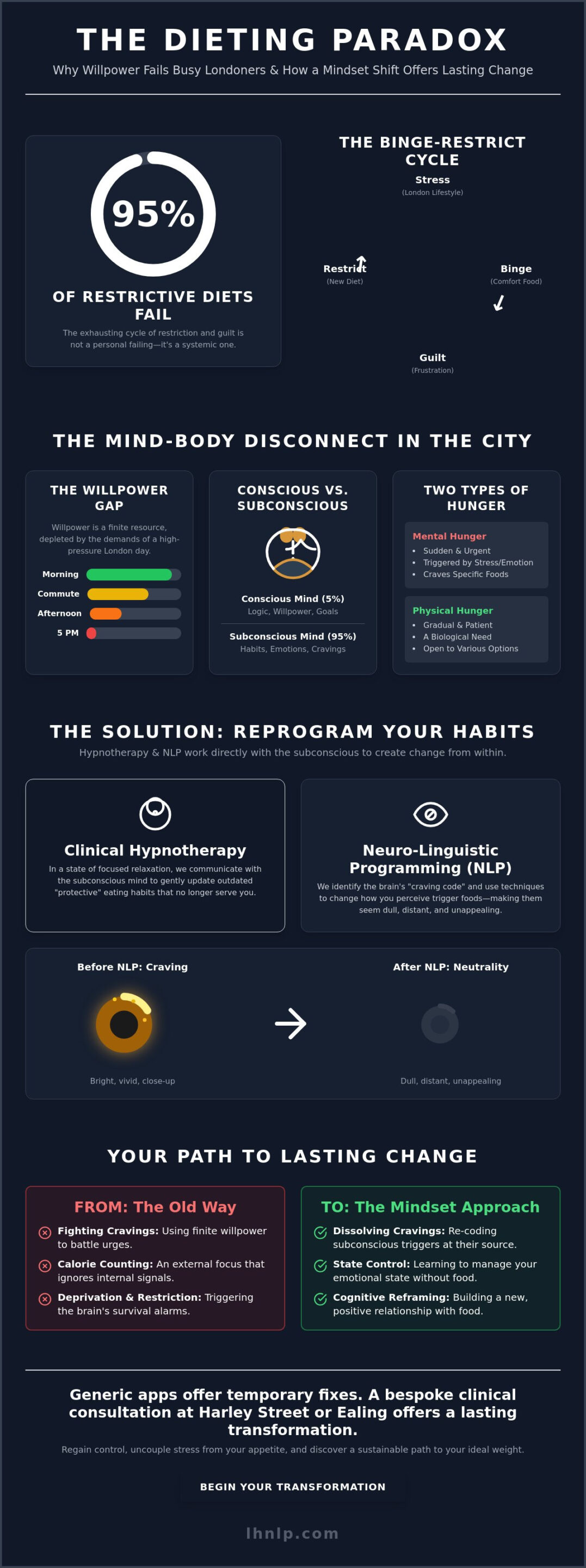
The relentless pace of life in the capital creates a unique set of challenges for the subconscious mind. Between high-stakes careers in Canary Wharf and the constant availability of convenience food, the brain often defaults to survival mode. This is where the willpower gap emerges. Your conscious mind wants health, but your subconscious seeks immediate comfort to offset the day’s stress. Understanding this friction is the first step toward lasting change.
To better understand this concept, watch this helpful video:
Distinguishing between mental hunger and physical hunger is a skill that most Londoners have lost in the rush of commuting and back-to-back meetings. Physical hunger is a gradual biological need. Mental hunger is a sudden, emotional craving triggered by a cortisol spike or a difficult conversation. Addressing these triggers often requires more than just logic; it requires accessing the deeper layers of the mind. Evidence-based practices like Hypnotherapy offer a way to communicate directly with the subconscious to resolve these internal conflicts.
The Failure of Restrictive Eating
Deprivation is a biological alarm. When you severely limit your intake, the brain triggers an ancient survival mechanism designed to protect you from famine. This leads to the exhausting binge-restrict cycle that many find themselves trapped in. Willpower is a finite resource. By the time 5 PM arrives, most professionals have exhausted their mental energy on decision-making, leaving them vulnerable to the convenience food trap. Calorie counting doesn’t just fail the body; it takes a significant toll on mental health and cognitive performance.
Shifting the Focus to Mindset
Your relationship with food isn’t an innate trait; it’s a learned behaviour reinforced by years of repetition. Neural pathways in the brain act like well-worn paths in a park; the more you walk them, the deeper they become. Shifting your focus to mindset allows you to forge new paths that prioritise well-being over temporary comfort. By exploring professional treatments that target these cognitive patterns, you can begin to lose weight without dieting London by changing how your brain perceives reward and satisfaction. This is the essence of a sustainable, mindset-first approach.
The Science of the Subconscious: How Hypnotherapy and NLP Re-program Habits
Most individuals trying to lose weight without dieting London based professionals often find that willpower alone fails because it only addresses the conscious mind. Clinical hypnotherapy operates on a deeper level; it facilitates a state of focused relaxation where the subconscious becomes receptive to constructive change. While your conscious mind might be busy counting calories, your subconscious is often running outdated scripts from years ago. NLP (Neuro-Linguistic Programming) acts as the bridge here, identifying the specific “language” your brain uses to create a craving. If your mind perceives a sugary snack as a bright, vivid, and close-up image, NLP techniques allow you to alter those sub-modalities, making the same food appear dull and distant until the urge simply fades away.
To achieve lasting results, we must address the “Secondary Gain.” This is the hidden benefit your subconscious believes it receives from overeating or maintaining weight. For many, food acts as a protective shield or a primary source of comfort during a stressful 50-minute commute. If your mind believes that extra weight provides a layer of safety, it’ll resist every traditional diet you attempt. By uncovering these underlying motives, we can satisfy the need for protection or comfort through healthier avenues, removing the subconscious “need” for excess weight.
The process of anchoring provides a practical way to break negative associations with food. Anchoring involves linking a specific physical gesture or mental image to a state of calm or self-control. When you face a high-pressure situation at work, you can trigger this anchor to instantly shift your state, preventing the typical spiral into stress-eating. It’s about replacing an automatic reaction with a conscious choice.
Breaking the Emotional Eating Loop
Hypnotherapy allows us to quiet the “emotional hunger” signal that often masquerades as physical need. By accessing the subconscious, we use the power of suggestion to create a natural, unforced preference for nourishing choices that leave you feeling energized. NLP reframes your internal dialogue so that you move from the restrictive mindset of “I can’t have that” to the empowered realization of “I don’t want that.”
Neuroplasticity and Lasting Change
Modern science confirms that our brains are capable of neuroplasticity, which is the ability to rewire neural pathways for automatic, healthy decision-making. Unlike the temporary nature of restrictive diets, these behavioral and lifestyle changes become a permanent part of your identity. You aren’t just “trying” to be healthy; you’re becoming someone for whom health is the default setting. Kamal serves as a mentor in this transformative journey, providing the guidance needed to navigate these internal shifts. If you feel ready to move beyond the cycle of restriction, exploring these specialised treatments can be the first step toward a different relationship with yourself.
Navigating the London Lifestyle: Stress, Commuting, and Weight
The most frequent objection I hear from professionals in the City is a simple, weary admission: “I’m just too stressed to focus on my health.” It’s a sentiment that resonates through the glass towers of Canary Wharf and the historic streets of the Square Mile. When your calendar is a back-to-back sequence of high-stakes meetings, the idea of calorie counting feels like an impossible burden. However, what if the stress itself is the very mechanism preventing you from reaching your goals? Understanding this connection is the first step to lose weight without dieting London professionals can actually sustain.
In high-pressure environments, your body exists in a state of chronic “fight or flight.” This triggers a sustained release of cortisol, a hormone that historically helped us survive external threats. In a modern context, cortisol signals your body to protect its energy reserves, specifically by promoting fat storage in the abdominal area. It’s a biological insurance policy against a famine that never arrives. When you’re under constant pressure, your biochemistry is effectively working against your waistline, regardless of how “clean” you try to eat.
The “Commuter Craving” is another uniquely London phenomenon. Have you ever noticed an urgent need for a sugary snack the moment you emerge from a delayed journey on the Central Line? This isn’t a lack of willpower. A stressful commute is a sensory assault that depletes your cognitive resources. Your brain seeks a rapid dopamine hit to self-soothe and rebalance your nervous system. By the time you reach your front door, your “decision fatigue” is so high that choosing a balanced meal feels mentally exhausting. Recognizing that these cravings are neurological responses rather than personal failings allows you to approach change with compassion rather than guilt.
Stress Management as a Weight Loss Tool
True transformation begins by addressing the nervous system’s state. When you learn to transition from a sympathetic (stressed) state to a parasympathetic (relaxed) state, your body stops prioritizing fat storage. For those working in high-cortisol environments, mastering these internal shifts is more effective than any restrictive meal plan. You can explore these techniques further in our guide on Stress Management in London. Once the internal “alarm” is turned off, the urge to self-soothe with food naturally diminishes.
Mindful Living in a Fast-Paced City
Integrating NLP techniques like “state control” helps you stay present during a chaotic workday. Instead of “desk-dining” while answering emails—a habit that prevents your brain from registering fullness—we focus on mental reframing to reclaim the lunch hour as a period of cognitive recovery. Even a ten-minute mindful walk near the Thames can reset your hunger signals. For those with demanding travel schedules or long hours, our online hypnotherapy services provide a flexible way to build these mental anchors without adding another commute to your day. You can lose weight without dieting London by simply changing how your mind perceives the city’s pace.
Practical Steps to Shift Your Relationship with Food Today
True transformation doesn’t happen through deprivation; it occurs in the subtle spaces between a stimulus and your response. When you want to lose weight without dieting London life often presents a chaotic backdrop of late nights and quick meals. To navigate this, we must replace rigid rules with neurological pattern interrupts that return the power to your hands.
The “Three-Breath Rule” is one of the most effective NLP tools for reclaiming your autonomy. Before you take the first bite of any meal or snack, pause. Inhale deeply for four seconds, hold for two, and exhale for six. Repeat this three times. This simple act shifts your nervous system from “fight or flight” to “rest and digest.” It creates a 10-second window of awareness where the subconscious drive to inhale food is replaced by a conscious choice to enjoy it. Have you ever noticed how much more satisfied you feel when you’re actually present for the experience?
We also need to address “Food Anchors.” These are environmental triggers where your brain has associated a specific location with eating. Perhaps it’s the armchair where you always have a biscuit while watching the news, or the specific corner of your office desk in the City. By identifying these anchors, you can begin to break the link. Try moving your tea to a different side of the desk or changing your seating position. These small shifts disrupt the automated habit loop that leads to mindless grazing.
Mastering the Internal Dialogue
The way you speak to yourself determines your metabolic reality. Language like “I must stay on track” or “I shouldn’t have that” creates internal resistance. When you use “should,” you’re essentially fighting a war against yourself. Instead, use empowering, choice-based language. Try saying, “I choose to eat this because it makes me feel vibrant,” or “I’m choosing to wait because I’m not truly hungry yet.” This puts you back in the driver’s seat. It’s the most sustainable way to lose weight without dieting London professionals have found to maintain long-term results.
If a “slip-up” occurs during a high-pressure week, don’t let it spiral into guilt. A single meal doesn’t define your progress. Use the “Volume Control” technique: visualize the critical voice in your head as a small dial on a radio. When it starts to shout about failure, mentally reach out and turn the volume down until it’s just a faint, harmless whisper. You’re the one holding the dial; you decide which voices deserve your attention.
Environment Design for Success
Your surroundings should support your goals without requiring constant willpower. Research suggests that people who keep fruit on their counters weigh an average of 13 lbs less than those who don’t. In your home, clear the visual cues of processed snacks. Use “State Control” during high-pressure meetings to manage emotional hunger. Before a stressful call, anchor a feeling of calm by touching your thumb and forefinger together, recalling a moment of total confidence. This prevents you from reaching for sugar to soothe the stress. For deeper structural changes, explore our Weight Loss Hypnotherapy Pillar to align your subconscious with your physical goals.
Your Path to Lasting Change with London Hypnotherapy & NLP
Choosing to lose weight without dieting London clients often find is less about the contents of the plate and more about the subconscious architecture of the mind. At LHNLP, the process begins with a personalised consultation at our Harley Street or Ealing clinics. This initial meeting serves as a bridge between your current frustrations and a future defined by intuitive, healthy choices. It’s a dedicated space where we peel back the layers of habitual behaviour to find the root cause of your struggle with food, moving beyond the surface-level symptoms of overeating.
There’s a fundamental difference between a generic weight loss app and a bespoke clinical session. Apps rely on external discipline, notifications, and data entry; these often feel like another chore on an already long to-do list. In contrast, our sessions focus on internal alignment. We don’t just track habits, we transform the subconscious triggers that create them. This clinical approach ensures that the changes you make aren’t temporary bursts of willpower, but permanent shifts in how you perceive yourself and your environment. It’s the difference between fighting your nature and evolving it.
What to Expect in a Session
When you step into our clinic, you’ll find a calm, professional environment designed to facilitate deep focus and reflection. The sessions are entirely tailored to your unique triggers, whether those are stress-related, social, or rooted in long-standing emotional patterns. Kamal utilizes a sophisticated blend of clinical NLP and hypnotherapy to help you navigate these internal landscapes with precision. It’s a partnership where your expertise on your own life meets Kamal’s expertise in the mechanics of human change. For those who want more clarity on the specific techniques or the duration of the process, we encourage you to view our frequently asked questions for peace of mind.
Booking Your Transformation in London
Accessibility is vital to maintaining the momentum of psychological change. We provide several locations across the city, including Harley Street and Tokenhouse Yard, ensuring that your sessions fit seamlessly into a busy professional schedule. While a single session can provide powerful insights, we offer multi-session packages for those committed to deep, structural change. This is more than a health goal; it’s an investment in a life where food no longer dictates your mood or your self-worth. To take the first step toward this new reality, you can contact Kamal for a consultation and begin the journey toward unshakeable confidence.
Step into a New Relationship with Your Body
The cycle of restrictive eating often leaves busy professionals feeling depleted rather than empowered. True transformation doesn’t happen on a plate; it begins within the intricate layers of your subconscious mind. By addressing the neurological triggers shaped by the high-pressure city lifestyle, you can finally lose weight without dieting London residents can actually sustain. You’ve seen how state control and reframing can dissolve the stress-response patterns that lead to emotional eating. Now, it’s time to move beyond temporary fixes and anchor yourself in a lifestyle of intuitive balance.
Kamal provides Harley Street clinical expertise backed by over 20 years of practitioner experience. This isn’t a generic program. It’s a personalised, solution-focused partnership that uses NLP and Hypnotherapy to align your inner world with your physical goals. You don’t have to fight your own biology to see results. Book your weight loss consultation with Kamal today and start the journey toward a lighter, more confident version of yourself. Your path to lasting change is ready when you are.
Frequently Asked Questions
Is weight loss hypnotherapy safe for everyone?
Weight loss hypnotherapy is a safe and non-invasive process for the vast majority of people seeking a sustainable change in their lives. While it feels like a state of deep relaxation, individuals with diagnosed clinical conditions such as epilepsy or certain psychiatric disorders should seek medical clearance from their GP first. It’s a collaborative journey where your psychological safety and comfort remain the absolute priority throughout every session.
How many sessions will I need to see results?
Most clients experience a profound shift in their relationship with food within 3 to 6 sessions. While every mind processes change at a unique pace, this timeframe allows us to address the root causes of overeating and anchor new, healthier habits into your daily routine. You’ll likely notice subtle, positive changes in your choices after the very first hour we spend together.
Can I really lose weight without counting any calories?
You can absolutely lose weight without dieting London by shifting your focus from external numbers to internal signals. When we reframe your unconscious response to hunger and fullness, your body naturally regulates its intake without the stress of spreadsheets or restrictive apps. This approach replaces the mental fatigue of constant calculation with a mindful, intuitive connection to your physical needs.
What happens if I cannot be hypnotised?
It’s a common misconception that some people cannot be hypnotised; in reality, trance is a natural state you enter daily while reading a book or daydreaming. If you feel a sense of resistance, we simply adjust the technique to match your unique cognitive style and personality. My role is to guide you gently into that receptive space where your internal resources become accessible for lasting change.
Does NLP work for sugar addiction specifically?
NLP is exceptionally effective for sugar addiction because it disrupts the neural pathways that trigger intense cravings. By using specific techniques like the Swish pattern or state control, we can neutralise the emotional pull that sweet foods hold over you. You’ll find that the old “need” for sugar simply loses its intensity, replaced by a sense of calm indifference and self-mastery.
How do hypnotherapy sessions in London differ from online sessions?
In-person sessions in our London clinic provide a dedicated, sensory-rich environment that helps many clients “switch off” from the city’s daily stressors. Online sessions offer the convenience and comfort of your own home, which can sometimes lead to a deeper sense of immediate security. Both formats are equally effective, as the most important work happens within the internal landscape of your own mind.
Will I lose control of my mind during a hypnotherapy session?
You remain in complete control throughout the entire session and can open your eyes or speak at any moment you choose. Hypnosis isn’t something done “to” you, but rather a collaborative state where you’re more aware of your inner world, not less. You’ll hear every word I say; your subconscious will only accept suggestions that align with your personal values and goals.
How soon can I book a weight loss consultation in Harley Street?
You can typically book a consultation at our Harley Street practice within 7 days, depending on our current clinic availability. We aim to respond to all initial enquiries within 24 hours to ensure your momentum for personal change is supported right from the start. Taking that first step is often the most significant part of the journey toward your new, healthier self.