

What if the reason you struggle to resist that late-night comfort food isn’t a lack of willpower, but a deeply ingrained protective mechanism your brain developed to cope with the high-pressure environment of London? You’ve likely spent years cycling through restrictive meal plans and expensive boutique gym memberships, only to find yourself sighing, “I’ve tried everything to lose weight,” as the familiar cycle of yo-yo dieting begins once again. It’s a demoralizing experience to feel “broken” or trapped by your own impulses, especially when the 95% failure rate of traditional diets suggests the problem isn’t your effort, but the method itself. How many times have you promised yourself that Monday would be different, only to have the stress of a commute or a demanding meeting trigger an old, unconscious pattern?
In this article, you’ll discover why your conscious mind can’t simply “will” away emotional eating and how clinical hypnotherapy in London can help you reprogram your subconscious for lasting, sustainable weight loss. We’ll explore the power of state control and unconscious framing to shift your internal narrative from one of deprivation to one of empowerment. This is your guide to understanding the psychological architecture of your habits and reclaiming your relationship with food without the exhausting struggle of white-knuckling your way through the day.
Key Takeaways
- Understand why the “diet-fail-repeat” cycle is often a psychological plateau rather than a metabolic one, reflecting the unique high-pressure environment of 2026 London.
- Discover the “Willpower Gap” and why logic alone cannot overcome the deep-seated subconscious habits and emotional triggers that lead to binging.
- Identify how the London lifestyle—from high-cortisol commutes to “time poverty”—contributes to the exhausting feeling that “I’ve tried everything to lose weight” without success.
- Learn how clinical hypnotherapy and NLP techniques like “Swish Patterns” bypass the mind’s critical factor to install new, permanent patterns of behavior.
- Explore how a structured, empathetic partnership at Harley Street, Ealing, or Tokenhouse Yard can finally align your conscious goals with your subconscious mind.
The ‘I’ve Tried Everything’ Paradox: Validating Your Frustration
You have likely stood in your kitchen in Richmond or Shoreditch, staring at another meal prep container, feeling the heavy weight of defeat. By 2026, the global wellness industry has reached record heights, yet the phrase “I’ve tried everything to lose weight” remains a painful mantra for thousands of Londoners. This exhaustion isn’t just physical; it’s a soul-deep fatigue that comes from the relentless “diet-fail-repeat” cycle. When you “try harder” by slashing another 500 calories, you’re often unknowingly triggering a psychological rebound that makes the next failure feel even more personal. This isn’t a lack of willpower; it’s a biological and mental standoff.
A weight loss plateau is rarely just about your basal metabolic rate or a slight miscalculation in your macros. From a psychological perspective, it represents a state of internal conflict where your conscious desire for change meets a subconscious wall of resistance. In a city that demands high performance every hour of the day, your mind eventually rebels against the added stress of restriction. This creates a paradox where the more mental energy you pour into “fixing” your body, the more your internal systems tighten their grip on the status quo.
To better understand why this cycle feels so impossible to break, watch this helpful video about the reality of trying every weight loss method:
The Exhaustion of the London Diet Culture
Living in London creates a unique pressure cooker for body image. Between the high-performance culture of the City and the polished aesthetics of West End social circles, “perfect body” imagery is inescapable. Every Tube journey and social media scroll floods your system with comparison-based stress, which keeps your cortisol levels chronically elevated. This environment makes it nearly impossible to listen to your body’s actual needs. In our weight loss treatments, we define “diet fatigue” as a clinical barrier where the mental energy required to sustain a restrictive lifestyle exceeds the individual’s current psychological resources, leading to a total shutdown of progress. When your brain is tired of the hustle, it’s also tired of the hunger.
Why Your Brain is Actually Trying to Protect You
Your subconscious mind isn’t your enemy; it’s a highly efficient survival mechanism that prioritizes safety over aesthetics. When you engage in extreme calorie restriction, your brain doesn’t see a “glow-up,” it perceives a famine. This triggers a biological defense mechanism known as Set point theory, which suggests your body has a predetermined weight range it fights to maintain through hormonal and metabolic shifts. If your internal goals are misaligned, meaning your subconscious associates being smaller with being vulnerable or unprotected, your brain will view weight loss as a threat to your survival. We must shift the narrative from “failure” to understanding these hidden internal protective parts that are simply trying to keep you safe in a demanding world.
Why Willpower Fails: The Science of the Subconscious Mind
Many people in London find themselves trapped in a cycle of restrictive dieting and intense gym sessions, only to end up back where they started. You might feel like you’ve tried everything to lose weight, yet the scales refuse to budge permanently. This isn’t a failure of character; it’s a failure of strategy. We often treat weight loss as a simple math problem of calories in versus calories out. However, your biology doesn’t care about your spreadsheets. It cares about your survival. When you rely solely on willpower, you’re using a tiny fraction of your mental capacity to fight a deeply ingrained system that’s designed to keep you exactly as you are.
The 5% vs. 95% Rule of Change
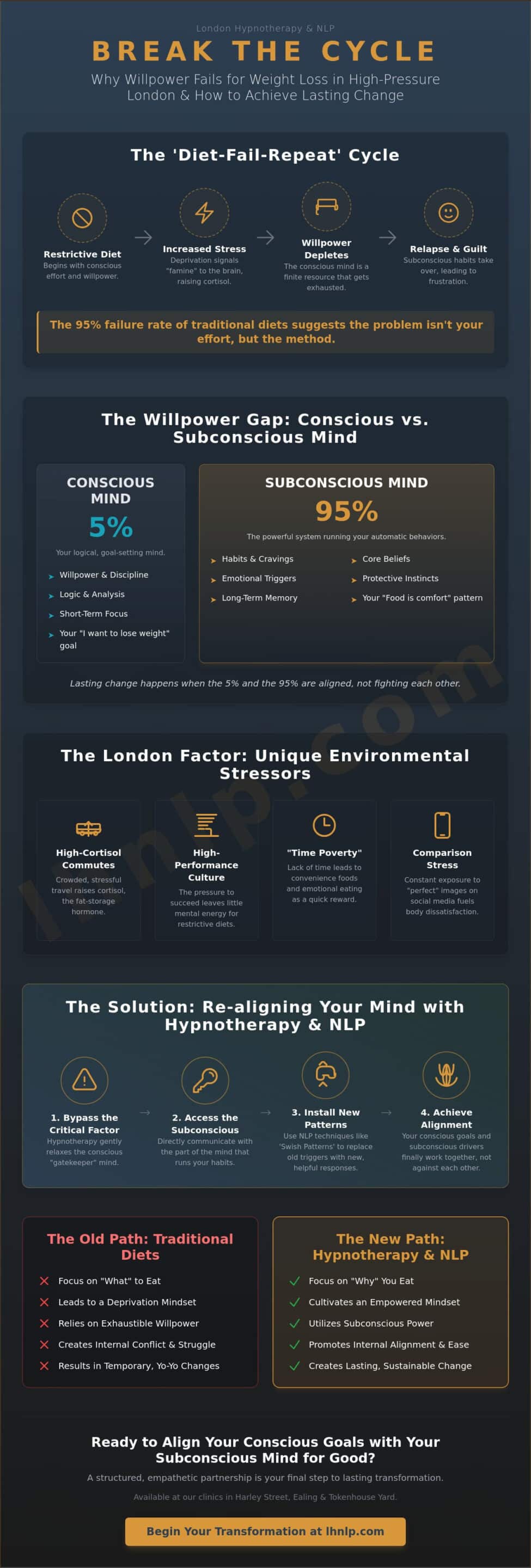
Your conscious mind represents only about 5% of your total brain power. This is where your logic, your New Year’s resolutions, and your willpower reside. It’s the part of you that decides to buy a gym membership or skip dessert. The remaining 95% is your subconscious mind, the vast, silent engine that controls your autonomic functions and, more importantly, your habits. This subconscious powerhouse manages roughly 2,026 daily habits automatically, from the way you breathe to the specific route you walk through your local supermarket. Research into a neuroscience-based approach to weight management shows that when the conscious mind and the subconscious mind disagree, the subconscious always wins. Trying to outthink your survival instincts with logic is like trying to stop a tidal wave with a handheld umbrella.
Identifying Your Subconscious ‘Weight Blueprint’
The mind operates on a “weight blueprint,” an internal set point it considers safe and familiar. If your subconscious associates being thinner with vulnerability or past trauma, it will trigger cravings and self-sabotage to return you to your “safe” weight. This is where Neuro-Linguistic Programming (NLP) becomes vital. NLP helps us identify “mental anchors,” which are specific triggers that link an external stimulus to an internal emotional state. For some, the smell of a specific food might trigger a childhood memory of comfort, making it impossible to resist through logic alone. Within the About Kamal and the LHNLP approach section of our work, we explore how these internal dialogues and metabolic successes are inextricably linked. If your internal voice is constantly critical, your body remains in a state of stress, which physically prevents fat loss.
Old childhood patterns often manifest as physical weight in adulthood. Perhaps you were told to “clear your plate” to be a good child, or maybe weight became a protective shield after a difficult experience. These aren’t just memories; they’re active programs running in your 95% mind. Until you address these underlying patterns, the phrase “I’ve tried everything to lose weight” will remain your reality. True transformation requires more than a new menu; it requires a systematic remapping of your internal landscape. If you’re ready to stop fighting yourself, you can explore our specialised NLP treatments to start shifting these deep-seated patterns today.
The London Lifestyle: Unique Barriers to Lasting Weight Loss
Living in the capital creates a specific set of psychological and physiological hurdles that few diet plans ever address. When you find yourself sighing, “I’ve tried everything to lose weight,” you’re likely ignoring the invisible impact of the London grind. Time poverty is a very real phenomenon here. Between ten-hour workdays and the inevitable delays at Waterloo or Clapham Junction, your schedule is often stretched to its breaking point. This leaves you with a depleted reservoir of willpower by the time you’re deciding what to eat for dinner.
The environment itself plays a role in your biology. A morning commute on the Central Line, with its cramped carriages and soaring temperatures, triggers a significant spike in cortisol. This stress hormone is a primary driver for abdominal fat storage and intense sugar cravings. By the time you reach your desk in the City or Canary Wharf, your brain is already screaming for a quick dopamine hit from a pastry or a sweetened coffee. Traditional dieting fails because it tries to fight this biological urge with logic, whereas hypnotherapy works to recalibrate your unconscious response to these city-specific stressors.
Corporate “pub culture” presents another unique barrier. Networking often revolves around pints and calorie-dense gastro-pub food, making it feel as though choosing health is a choice to be socially isolated. For the busy professional, finding a solution that doesn’t require hours of meal prep is essential. This is where mindset work becomes the most time-efficient tool in your arsenal; it changes your defaults so you don’t have to spend mental energy resisting the office snack culture or the post-work drinks.
Stress-Induced Eating in the City
There’s a direct physiological link between the high-pressure London work environment and how your body processes fuel. Chronic stress keeps your nervous system in a state of “fight or flight,” which prioritises immediate energy over long-term health. Through NLP State Control, you can learn to shift your internal landscape in seconds. Instead of reaching for chocolate to soothe a stressful afternoon of meetings, you can anchor yourself in a state of calm and focus. Research supports this shift; for instance, Hypnotherapy and self-hypnosis have been shown to significantly improve weight loss outcomes by addressing the underlying emotional triggers that lead to overeating. You can explore more about managing city stress at LHNLP to see how these techniques apply to your daily routine.
Breaking the ‘Grab-and-Go’ Habituation
London’s transport hubs are designed to exploit your hunger. From the smell of fresh bread at Paddington to the easy convenience of “meal deals” at every corner, your brain becomes habituated to “grab-and-go” eating. This is rarely about hunger and almost always about convenience and habit. Hypnotherapy helps you install “Mindful Eating” as your default setting, even when you’re in a rush. To maintain your mindset during a busy week, try these practical steps:
- The Three-Breath Rule: Before buying any food at a station, take three deep breaths to exit the “commuter autopilot” mode.
- Hydration Anchoring: Drink 250ml of water before every meal to signal your body that its needs are being met.
- Visual Framing: Briefly visualise how you want to feel at the end of the day before making a food choice during your lunch break.
When you realise that “I’ve tried everything to lose weight” usually means you’ve tried everything except changing your internal response to London life, the path forward becomes clear. It’s about working with your mind, not against your schedule.
How Hypnotherapy and NLP Create a Permanent Shift
When you feel as though I’ve tried everything to lose weight, the frustration often stems from a hidden conflict between your conscious desires and your subconscious programming. Clinical hypnotherapy works by gently bypassing the ‘critical factor’ of the mind, a concept identified by pioneer Dave Elman as the analytical filter that rejects suggestions conflicting with established habits. By quieting this gatekeeper, we speak directly to the part of your mind that controls automatic behaviours, making healthy choices feel natural rather than a daily struggle of willpower.
Neuro-Linguistic Programming (NLP) adds a layer of precision to this transformation. We use techniques like ‘Swish Patterns’ to take the mental image of a craving and instantly replace it with a more empowering vision of your future self. We also employ ‘Reframing’ to change your internal narrative; instead of seeing a missed workout as a failure, we treat it as neutral data, allowing you to adjust without the heavy burden of guilt. This approach treats excess weight as a symptom of an underlying cognitive pattern, rather than the primary problem. If you’ve tried everything to lose weight, it’s likely because your conscious effort was fighting a subconscious blueprint that hadn’t been updated in years.
Reprogramming Your Relationship with Food
Most weight loss attempts fail because they ignore the emotional charge attached to certain foods. Through hypnosis, we neutralise these triggers, transforming a desperate ‘need’ for sugar into a neutral observation. We focus on installing new default behaviours so that your brain automatically reaches for hydration or a short walk when stressed, rather than the biscuit tin. You can explore a deep dive into weight loss hypnotherapy to understand how this cognitive shift creates lasting change through a mindset-first approach.
What a Session in Harley Street or Ealing Looks Like
A typical 60-minute session in my Harley Street or Ealing practice is a collaborative, solution-focused experience grounded in clinical science. We don’t spend hours dwelling on the past; we focus on building the ‘Unshakeable Confidence’ you need to navigate London’s busy social and professional environments. For those living outside the capital or with restrictive schedules, my online hypnotherapy services provide the same level of professional support from the comfort of your own home. This process is about reclaiming your agency and proving that your past attempts don’t define your future success.
Your Path to Transformation at London Hypnotherapy & NLP
If you feel like you’ve reached your limit and the phrase “I’ve tried everything to lose weight” has become a daily mantra of frustration, you’re in the right place for a genuine breakthrough. At LHNLP, we specialize in partnering with individuals who have exhausted the traditional avenues of calorie counting and grueling gym schedules without seeing lasting results. Our practice operates across three key London hubs: the historic clinical excellence of Harley Street, the accessible suburbs of Ealing, and the professional heart of Tokenhouse Yard in the City. We don’t rely on generic, one-size-fits-all scripts that treat every mind as a carbon copy. Instead, we map your unique psychological landscape to identify the specific anchors holding your old habits in place. Your past attempts aren’t signs of personal weakness; they’re valuable data points that show us exactly where your conscious intentions and unconscious protective mechanisms are misaligned.
The LHNLP Multi-Session Advantage
Lasting neurological change rarely happens in a single hour. We utilize a multi-session package approach because deep-seated behavioral patterns require consistent reinforcement and strategic reframing to dissolve. During your initial consultation with Kamal, you’ll move beyond the surface-level symptoms of overeating. You’ll begin to understand the “secondary gain” your current weight might be providing your subconscious mind. This first meeting is about clarity and establishing a roadmap for your cognitive evolution. It’s the moment where we stop looking at the scale and start looking at the mental architecture driving your choices. To begin this process, you can contact us to book your London session and take the first step toward a different version of yourself.
Real Change Starts with a Single Decision
It’s natural to feel a sense of skepticism when you’ve been disappointed by the weight loss industry for years. We invite you to shift from a “testing” mindset to a “discovery” mindset. Clinical hypnotherapy in London provides the mental infrastructure that willpower alone cannot build. This isn’t about “trying” harder; it’s about evolving into a person who no longer needs the old coping mechanisms that led to weight gain. When you align your unconscious drivers with your conscious goals, the internal friction dissipates. You’re not fighting yourself anymore; you’re finally moving in one direction. Even if you feel like you’ve tried everything to lose weight before, this methodology addresses the root cause rather than the symptom. Stop repeating the cycle of effort and failure. Choose to start your evolution today and reclaim the authority over your own body and mind.
Your Journey Beyond the Cycle of Frustration
Real transformation doesn’t happen through another restrictive diet or a punishing gym schedule in the heart of the City. It begins when you address the subconscious patterns that have kept you stuck for years. You might feel like I’ve tried everything to lose weight, but traditional methods often ignore how the fast-paced London lifestyle impacts your nervous system. By integrating specialized NLP and hypnotherapy, we move past temporary willpower to create a permanent shift in how your mind perceives food and stress.
With over 20 years of clinical experience in London, our approach combines specialized NLP and hypnotherapy certifications with a deep understanding of the psychological barriers unique to high-pressure environments. Whether you visit us at our Harley Street, Ealing, or City locations, you’ll find a supportive space designed for lasting change. It’s time to stop fighting against your own mind and start working with it. Every step you’ve taken so far was simply part of the learning process that brought you here.
Ready to break the cycle? Book your personalized weight loss consultation in London today.
You possess the internal resources needed for this change; we’re simply here to help you unlock them.
Frequently Asked Questions
Is hypnotherapy for weight loss safe and how many sessions will I need?
Hypnotherapy is a safe, non-invasive process where you remain in complete control, typically requiring 3 to 5 sessions for lasting change. Unlike clinical sedation, it’s a natural state of focused attention. A 2014 study in the International Journal of Clinical and Experimental Hypnosis found that participants using hypnosis lost more weight than 90 percent of those in the control group. This focused approach allows us to address the specific neural patterns driving your habits.
I’ve tried everything to lose weight and nothing works; why is this different?
This approach is different because it addresses the neurological “why” behind your habits rather than just the “what” on your plate. If you feel like I’ve tried everything to lose weight and failed, it’s because traditional diets only target the conscious mind. By working with the subconscious, we resolve the internal conflicts that lead to self-sabotage. We move beyond willpower into a state of natural alignment where healthy choices feel effortless.
Can NLP really stop me from craving sugar and emotional eating?
NLP techniques like state-control and anchoring can effectively neutralize sugar cravings and emotional eating triggers within a single session. We identify the specific mental map you have for sweets and re-code that internal representation. Research by the University of Roehampton suggests that psychological interventions are 40 percent more effective for weight management when they address emotional regulation. It’s about changing your brain’s response to stress so food isn’t the primary comfort.
Do I have to go into a deep trance for weight loss hypnosis to work?
You don’t need to enter a deep, unconscious trance for weight loss hypnosis to be highly effective. Most therapeutic work happens in a light to medium state of relaxation, similar to being absorbed in a good book. You’ll hear every word I say and can stop the process at any time. This collaborative state allows your subconscious to become receptive to new suggestions while your conscious mind remains comfortably present.
How much does weight loss hypnotherapy in London cost compared to diets?
Private hypnotherapy in London typically costs between £150 and £350 per session, which represents a long-term saving compared to the UK’s £2 billion annual spend on revolving diet products. While a gym membership or meal plan requires ongoing monthly payments, mindset work is an investment in a permanent internal shift. You’re paying for a specialized skill set that resolves the root cause; this saves you thousands of pounds on future weight loss attempts.
What happens if I can’t be hypnotized or I’m too analytical?
Being analytical is actually an asset in NLP and hypnotherapy because it shows you have a strong, active mind. Everyone with a normal level of concentration can experience the benefits of trance. If you’re someone who thinks I’ve tried everything to lose weight but my mind won’t quiet down, we use specific “Uptime” techniques to engage your logic. We work with your analytical nature rather than fighting against it to create change.
Are the results from hypnotherapy permanent or will I gain the weight back?
Results are designed to be permanent because we’re physically restructuring the neural pathways in your brain. When you change the subconscious belief system that governs your metabolism and hunger, the “yo-yo” effect of traditional dieting disappears. A landmark 1996 meta-analysis showed that individuals using hypnosis maintained their weight loss over a two-year follow-up period. This isn’t a temporary fix; it’s a fundamental evolution of your relationship with yourself.
Can I do these sessions virtually via Zoom if I can’t get to Harley Street?
You can absolutely experience the full benefits of these sessions via Zoom from the comfort of your own home. Research published in the Journal of Medical Internet Research in 2021 indicates that virtual therapy is just as effective as in-person sessions for behavioral change. Many clients find they can relax more deeply in their own environment. As long as you have a stable internet connection and a quiet space, the results remain identical to an office visit.