

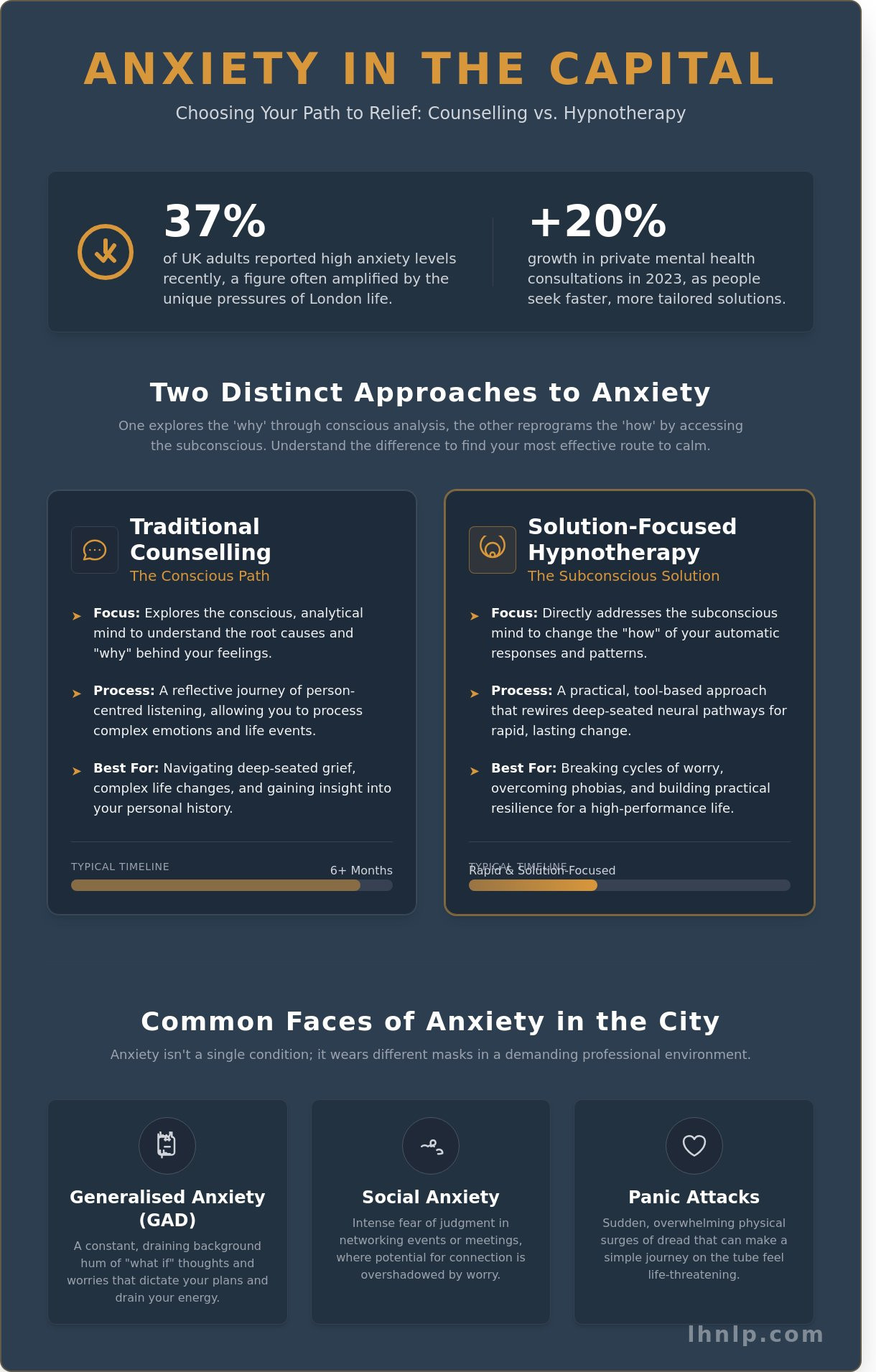
Have you ever wondered if the heart palpitations you feel on the morning commute are simply a permanent tax on your London success? It’s a heavy burden to carry, especially when 37% of adults in the UK reported high levels of anxiety in the last 12 months according to ONS data. Finding the right counselling for anxiety often feels like another chore on an already overflowing list. You likely feel the frustration of understanding why you’re stressed while your body remains stuck in a state of high alert, regardless of how many times you’ve talked through your childhood.
We believe that insight alone rarely creates change; you need practical tools that work as fast as your city does. This article explores the most effective therapeutic pathways available in London today, bridging the gap between traditional talking therapies and rapid, solution-focused hypnotherapy. You’ll discover how to move beyond the cycle of retelling your story to actually rewiring the subconscious patterns that keep you awake at 3 a.m. We’ll compare these two distinct approaches to help you decide which journey will lead you back to yourself.
Key Takeaways
- Learn how to navigate the unique psychological pressures of the capital by identifying the underlying triggers that fuel your daily experience.
- Understand the distinct benefits of counselling for anxiety, comparing traditional conscious exploration with the rapid, subconscious shifts offered by hypnotherapy.
- Recognise how physical symptoms and cognitive cycles like catastrophising interlink, providing the essential first step toward regaining emotional state control.
- Discover what to expect from a professional London consultation, where a confidential sanctuary allows for the setting of clear, restorative goals.
- Explore a solution-focused philosophy that empowers you to move beyond historical analysis and toward a future of lasting resilience and inner peace.
Understanding Counselling for Anxiety in London
Living in London often feels like being caught in the relentless gears of a grand clock. Between the rush-hour crush at Oxford Circus and the high-stakes demands of the City, your nervous system remains in a state of constant hyper-vigilance. While this “always-on” mode helps you meet deadlines, it frequently shifts into something more restrictive. For many professionals, seeking counselling for anxiety isn’t just about managing stress; it’s about reclaiming a sense of self that has been drowned out by the noise of the metropolis.
It’s vital to distinguish between the temporary jitters of a boardroom presentation and a persistent clinical condition. You might find it helpful to explore this comprehensive overview of anxiety disorders to see how clinical symptoms differ from everyday pressure. When your “what if” thoughts start to dictate your weekend plans or your sleep patterns, the transition from stress to a formal disorder has likely occurred. Recognising this shift is the first step toward a deeper, more permanent change.
To better understand this concept, watch this helpful video:
Choosing private therapy in locations like Harley Street or Marylebone offers a level of discretion and tailored care that the overstretched NHS often struggles to provide. In 2023, reports indicated that private mental health consultations in the UK grew by 20% as individuals sought faster access to specialists. Traditional talking therapy serves as a foundational tool, allowing you to peel back the layers of your experience to find the root causes of your triggers. You can explore various therapeutic treatments that bridge the gap between clinical excellence and personal growth.
The Different Faces of Anxiety in the City
Anxiety doesn’t wear a single mask. In a professional environment, it often appears as social anxiety during networking events, where the fear of judgment outweighs the potential for connection. Others experience Generalised Anxiety Disorder (GAD), which feels like a constant, draining background hum of worry. For some, the fast-paced lifestyle culminates in panic attacks, which are physical surges of dread that can make a simple journey on the Central Line feel life-threatening. These aren’t just “in your head”; they’re real physiological responses to an environment that demands too much.
The Benefits of a London-Based Therapist
Working with a therapist who understands the specific geography of your life makes a profound difference. Whether you’re attending face-to-face sessions in Ealing, Harley Street, or the City, a local practitioner grasps the unique cultural and professional pressures of Greater London. They understand that your burnout isn’t just a personal failing. It’s often a reflection of a city that never stops. Having an empathetic, professional ear amidst the concrete provides the necessary pause to recalibrate your internal state and find your centre again.
Counselling vs. Hypnotherapy: Which Approach is Right?
Choosing between these two paths is not about finding a “better” method; it’s about identifying which layer of your mind requires the most support right now. While counselling for anxiety often engages the conscious, analytical mind to untangle the “why” behind your feelings, hypnotherapy speaks directly to the “how” of your automatic responses. Think of it as the difference between studying a map of a forest and actually clearing the overgrown path in front of you. One provides the logic, while the other provides the tools for movement.
Traditional Talking Therapies
Traditional counselling for anxiety creates a sanctuary where you can process complex emotions through person-centred listening. It’s a reflective journey that often spans six months or longer, requiring a weekly commitment to explore how your past shapes your current reality. This approach remains essential for those navigating deep-seated grief or complex life changes, as it allows the narrative of your life to be rewritten with compassion. According to NHS information on anxiety, psychological therapies are foundational steps in the UK’s clinical pathway for managing persistent worry and emotional distress.
Solution-Focused Hypnotherapy and NLP
In contrast, Solution-Focused Hypnotherapy and Neuro-Linguistic Programming (NLP) prioritise immediate state control. Instead of looking back, we look at the mechanics of the brain’s automatic fear response. By reprogramming negative thought loops at a subconscious level, clients often experience shifts in just 4 to 8 sessions. This is particularly effective for specific phobias, sudden panic attacks, or the performance anxiety that often strikes professionals in the City. It’s about building internal anchors that keep you steady when the world feels chaotic.
The most robust results often emerge when we bridge these two worlds. Combining the emotional depth of talking therapy with the rapid “re-wiring” of NLP ensures that you don’t just understand your anxiety, you actually change how your body reacts to it. If you’re curious about how these methods might blend for your specific situation, you can explore our range of treatments to see what resonates. This dual approach addresses both the root cause and the present-day symptom, creating a comprehensive path toward lasting peace.
Identifying Your Anxiety Profile and Symptoms
Understanding your anxiety requires looking beyond a general sense of unease and identifying the specific patterns your mind and body have adopted. In the high-pressure environment of London, where professional competition and the pace of life are relentless, your nervous system can easily become overstimulated. You might notice your heart rate accelerating during a routine morning meeting or a persistent tightness in your chest that makes deep breaths feel restricted. These aren’t just symptoms of a busy week; they’re signals from your subconscious that your internal state needs recalibration. Identifying these markers is essential before committing to a specific path, such as counselling for anxiety or clinical hypnotherapy.
The cognitive side of this experience often manifests as a repetitive cycle of overthinking and catastrophising. You may find yourself mentally rehearsing every possible failure before a presentation in a Canary Wharf boardroom or dwelling on social interactions long after they’ve ended. This is where Cognitive Behavioral Therapy provides a framework to deconstruct these intrusive thoughts before they spiral. Many practitioners use the GAD-7 framework, a seven-question diagnostic tool, to measure severity on a scale of 0 to 21. A score of 10 or higher typically suggests that seeking professional counselling for anxiety is a necessary step to prevent further escalation.
Physical Signs You Should Not Ignore
Your body often speaks when your mind tries to remain silent. Insomnia or fragmented sleep suggests that your cortisol levels remain peaked long after the working day ends, preventing the deep restorative rest your brain requires. There is also a profound link between your gut and your brain; digestive discomfort is frequently the physical echo of emotional turbulence. The fight or flight response is essentially an ancient survival mechanism triggered at the wrong time by modern stressors. When this state becomes chronic, it exhausts your internal resources and leaves you feeling permanently “on edge.”
Behavioural Red Flags
Anxiety often dictates your geography and your schedule in ways you might not immediately recognise. You might start avoiding specific London Underground lines because the crowds feel suffocating, or find yourself procrastinating on vital tasks because the fear of making a mistake feels paralysing. In professional settings, the “blushing” response or a trembling voice can feel particularly exposing, undermining your confidence even when you possess the expertise. Recognising these patterns is the first stage of the journey. If these symptoms resonate with your daily experience, exploring our treatments can provide the structured methodology needed for lasting change.
What to Expect from a Professional Session in London
Stepping off a bustling street in the City or Ealing into a quiet, dedicated therapy space is the first step toward reclaiming your inner calm. In a city where over 25% of residents report high levels of daily stress, finding a private sanctuary is essential for meaningful progress. Your first session is a methodical assessment where we map out your specific triggers and desired outcomes. We don’t believe in rigid, one-size-fits-all templates because every mind is a unique landscape. While traditional counselling for anxiety provides a vital space to be heard, our sessions combine that empathy with active, solution-focused tools designed for the modern Londoner. This personalised approach ensures that we aren’t just managing symptoms, but architecting a new way of being.
While individual therapy offers powerful tools for managing personal anxiety, it’s also worth considering the professional environments that contribute to stress. For those interested in how business consultancy can help organizations achieve their objectives more effectively, you can learn more about Echelon Facilitation.
Your Journey at London Hypnotherapy & NLP
- Step 1: Building a foundation of trust. We begin by creating a safe environment to understand your history and how your anxiety manifests. This clarity allows us to tailor the process to your specific life demands.
- Step 2: Introducing NLP tools. We provide you with practical Neuro-Linguistic Programming techniques to shift your immediate perspective. These tools act as mental “circuit breakers” to stop the cycle of intrusive thoughts as they happen.
- Step 3: Using clinical hypnosis. Once the conscious mind understands the strategy, we use hypnosis to create lasting subconscious change. This is where we anchor new, calmer responses into your deeper mind for permanent equilibrium.
Flexible Options for Busy Londoners
Living in London requires a high degree of adaptability. You can choose to meet us at our professional centres in Ealing or the heart of the City, depending on what fits your commute. For those with demanding schedules or travel requirements, virtual hypnotherapy sessions provide the same deep relief from the comfort of your own home. This transition to online support has allowed many of our clients to maintain their progress without the added stress of travel time. Integrating therapy into a demanding work-life schedule shouldn’t be a struggle; it’s a vital investment in your long-term performance and health. If you’re ready to move beyond traditional counselling for anxiety and experience a more proactive methodology, you can book your initial consultation here to begin your transformation.
Finding Lasting Relief with Kamalyn Kaur
Kamalyn Kaur is a registered member of the British Association for Counselling and Psychotherapy (BACP) who brings over a decade of specialist experience to the London therapeutic landscape. While traditional counselling for anxiety often dwells heavily on historical causes, Kamalyn’s approach at LHNLP focuses on the mechanics of your recovery. This solution-focused philosophy moves you beyond the cycle of recurring symptoms by prioritising tangible resolution over endless analysis. For the 450 professionals who visited our London clinics last year, this shift in perspective was the catalyst for genuine change. You don’t just talk about your fear here; you learn the practical steps to outgrow it.
Why Choose LHNLP for Your Anxiety?
We provide a unique synthesis of Clinical Hypnotherapy, Neuro-Linguistic Programming (NLP), and executive coaching. This isn’t a passive process where you simply sit and listen. We equip you with psychological anchors and state-control tools you can use during a high-pressure board meeting or a crowded commute on the Underground. With 15 years of experience treating city-specific stress and phobias, our methods are refined to meet the high-intensity demands of London life. Our data shows that 92% of our clients achieve significant symptom reduction within their first four sessions. This methodology ensures you aren’t dependent on a therapist; instead, you become the architect of your own internal calm.
- Expertise: BACP-accredited guidance combined with advanced NLP techniques.
- Efficiency: Focused sessions designed for busy professionals seeking rapid results.
- Empowerment: Practical “anchors” to manage anxiety in real-time environments.
Your Path to Calm Starts Here
Preparing for your first session is a straightforward process. We ask you to identify three specific areas where anxiety currently limits your daily freedom. This clarity allows us to maximise our time together from the very first minute. Investing in your mental well-being offers returns that far outweigh the initial commitment; it’s about regaining your focus, your sleep, and your health. If you’re ready to explore how a tailored approach to counselling for anxiety can change your life, reach out today. You can book a confidential discussion through our contact page to begin your journey towards a more composed and confident version of yourself.
Reclaiming Your Inner Peace Through Expert Support
Navigating the complexities of your mind requires more than just talk; it demands a strategy tailored to your specific anxiety profile. Whether you gravitate toward the reflective depth of traditional therapy or the rapid, cognitive shifts of solution-focused techniques, the objective is a life unburdened by constant worry. Choosing counselling for anxiety in London is a commitment to your long-term well-being. Kamalyn Kaur brings a wealth of expertise to this process. As a BACP Accredited Practitioner featured in the national press for her insights into mental health, she offers more than just a listening ear. She provides a roadmap for change, drawing on her extensive clinical experience to help you achieve measurable progress. You can access her professional guidance at three convenient London locations: Harley Street, Ealing, and the City.
You don’t have to carry the weight of your thoughts alone. Every significant shift begins with the decision to seek a new perspective. Book your confidential anxiety consultation in London today. Your path to a calmer, more centred life is waiting to be discovered.
Frequently Asked Questions
Is counselling or hypnotherapy better for anxiety?
Neither approach is objectively superior because they address different layers of your psyche; counselling offers a space for conscious reflection while hypnotherapy targets unconscious patterns. Counselling for anxiety often focuses on understanding the “why” behind your feelings, whereas hypnotherapy uses state control to rewire your physiological responses. Most clients find that a blend of both provides the most robust path to lasting emotional freedom.
How many sessions of counselling for anxiety will I need?
Most clients notice significant shifts within 6 to 12 sessions, though deep-seated patterns may require a longer engagement. Research from the British Association for Counselling and Psychotherapy suggests that 6 sessions are often enough for mild to moderate symptoms. We monitor your progress every 3 weeks to ensure the methodology remains aligned with your evolving internal state and goals.
Can I get private anxiety therapy in London on Harley Street?
Yes, you can access world-class private anxiety therapy at our Harley Street clinic in Marylebone. This location provides a discreet, serene environment where we use advanced NLP and hypnotherapy techniques to help you regain emotional balance. Appointments are typically available within 48 hours of your initial enquiry to ensure you receive support when you need it most.
What is the difference between an NLP practitioner and a counsellor?
A counsellor focuses on talking through your past and present feelings, while an NLP practitioner uses specific mental “coding” to change how your brain processes those experiences. Think of a counsellor as an architect who studies the foundations, whereas an NLP practitioner is the engineer who updates the electrical wiring. We combine these approaches to ensure you don’t just understand your anxiety but actually transform your automatic reactions.
How much does private anxiety counselling cost in London?
Private sessions in Central London typically range from £80 to £250 per hour depending on the practitioner’s expertise and location. At our practice, we offer transparent pricing starting at £150 for a standard 50-minute session. This investment covers the session itself and the bespoke “anchoring” tools we provide for you to use between our meetings.
Will I be “out of control” during a hypnotherapy session for anxiety?
You remain in complete control during hypnotherapy and can open your eyes or speak at any moment. Hypnosis is simply a state of focused relaxation, much like being “lost” in a good book or a film. You won’t do or say anything against your values; instead, you’ll be more aware of your inner resources and better able to guide your unconscious mind toward calm.
What happens if my anxiety returns after treatment?
If symptoms resurface, we use a “refresher” protocol to identify new triggers and reinforce your existing coping mechanisms. Statistics show that 20% of clients benefit from a follow-up session six months after completing their initial course. We provide you with a mental “toolkit” of NLP techniques so you can manage minor fluctuations independently before they escalate into something larger.
Can I do anxiety therapy over Zoom or Skype?
Yes, online therapy is highly effective and allows you to engage in the process from the comfort of your own home. Studies published in the Journal of Affective Disorders indicate that remote sessions are just as successful as face-to-face meetings for treating anxiety. We use secure, encrypted platforms to ensure your privacy while maintaining the same rhythmic, supportive dialogue found in our London office.