

On a Tuesday morning in January 2026, Sarah sat at her desk in Canary Wharf, her heart racing while her inbox swelled with 45 unread messages. Like the 41% of London professionals currently reporting clinical stress levels, she felt the weight of a city that never pauses. You probably recognize this tension; that quiet suspicion that your internal resources are stretched too thin. Choosing to explore anxiety medication isn’t a sign of defeat, but a conscious step toward reclaiming your state of mind from the noise of a high-pressure environment.
It’s natural to feel hesitant about side effects or confused by the technical differences between SSRIs and other options. You deserve a path to peace that respects both your biology and your lifestyle. This guide provides a clear roadmap through the medical landscape and how it interacts with your unique neurology. We’ll explore how to bridge the gap between pharmaceutical support and therapeutic alternatives, offering a way to move beyond the 18 month waiting lists for traditional talk therapy. By the end of this article, you’ll have a precise plan to integrate these tools into a lifestyle that supports your long term mental wellbeing.
Key Takeaways
- Understand how London’s high-pressure environment impacts your neurochemistry and why seeking professional support is a courageous step toward reclaiming your inner peace.
- Navigate the differences between common types of anxiety medication, such as SSRIs and beta-blockers, to make an informed decision alongside your healthcare provider.
- Compare biological and psychological interventions to understand how “top-down” and “bottom-up” approaches work together to reshape your response to stress.
- Identify the best route for your care in London, from maximizing a brief GP consultation to accessing specialized private psychiatric support in Harley Street.
- Discover how subconscious reprogramming through NLP and hypnotherapy can help you move beyond symptom management toward a lasting, internal state of calm.
Understanding Anxiety Medication: Why Londoners Seek Pharmacological Support
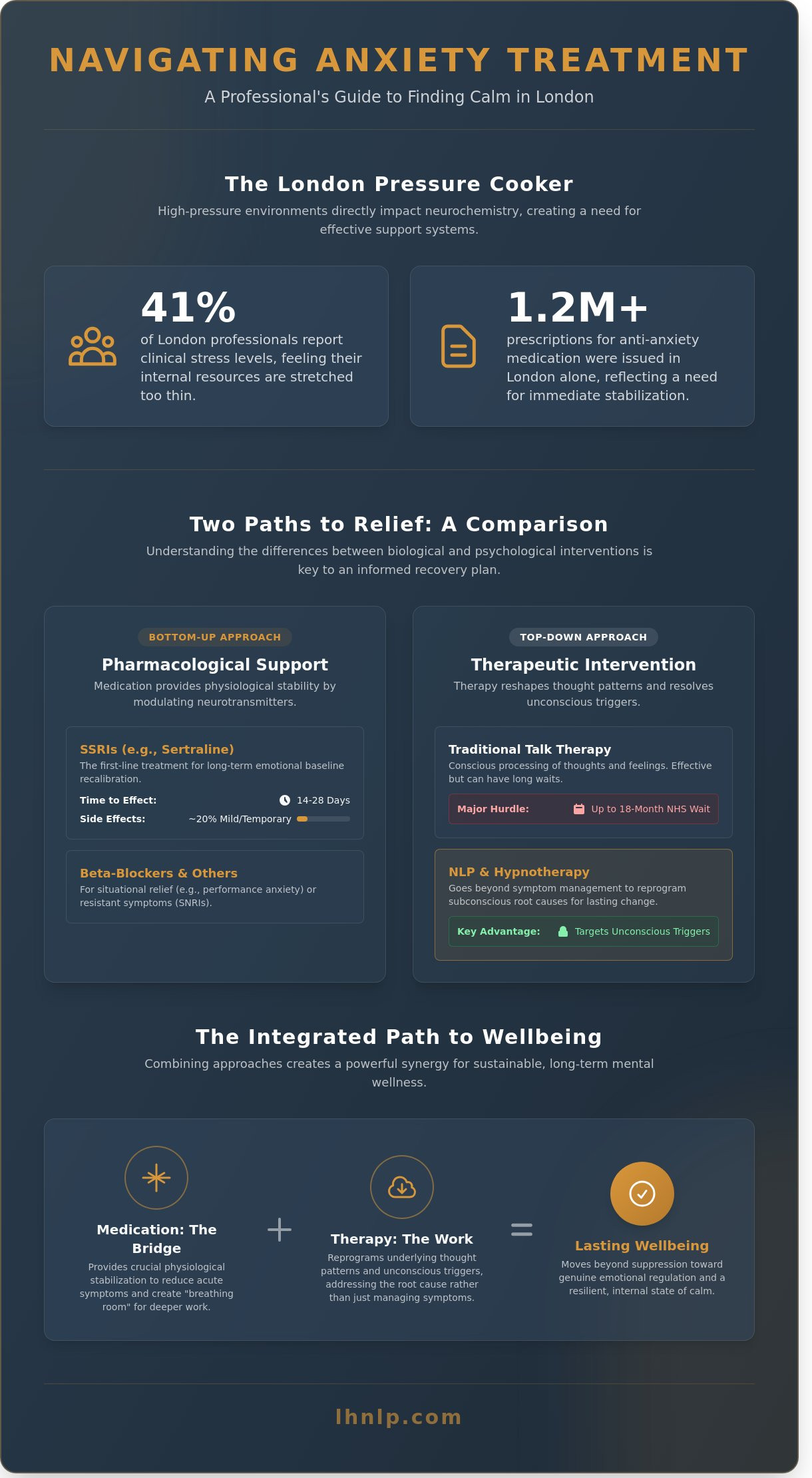
Anxiety medication describes a specific range of pharmaceuticals designed to modulate neurotransmitters like serotonin and GABA, helping the brain regain a sense of equilibrium. In a city where the “always-on” culture is the standard, these medications offer a way to manage the physiological noise of a high-pressure environment. Data from 2024 indicates that over 1.2 million prescriptions for various classes of anti-anxiety medications were issued in the London region alone. This surge reflects a growing need for immediate stabilization among professionals facing relentless deadlines and the sensory overload of urban life.
To better understand how these treatments interact with the mind and body, watch this expert overview:
The Biological Mechanism of Anxiety
The human “fight or flight” response, once essential for survival, often becomes trapped in a loop within the modern urban landscape. Constant noise, 24/7 connectivity, and the 8:00 AM commute keep the adrenal glands pumping cortisol and adrenaline into the system. When this state of high alert becomes chronic, the nervous system loses its ability to self-regulate. Medication often serves as the first port of call for those in crisis, providing the necessary “breathing room” to prevent total burnout and manage acute symptoms like panic attacks.
The ‘Quick Fix’ Allure vs. Long-term Management
London operates on a results-driven clock. This creates a natural desire for immediate relief through symptom suppression, especially when sleep disruption or social anxiety threatens one’s career performance in corporate settings. While a pill can lower the volume of a panic attack during a board meeting, it doesn’t necessarily rewire the underlying thought patterns or the unconscious triggers that started the fire. True progress requires moving beyond suppression toward emotional regulation. Anxiety medication serves as a vital tool for physiological stabilization, yet it functions as a bridge rather than a substitute for the internal work required to address the root causes of distress.
- Stabilization: Reducing the intensity of physical symptoms to allow for cognitive work.
- Symptom Management: Addressing immediate barriers like chronic insomnia or heart palpitations.
- Functional Support: Enabling individuals to remain active in their professional and social roles during recovery.
A Comparison of Common Anti-Anxiety Meds: From SSRIs to Beta-Blockers
Choosing the right pharmacological support requires a delicate balance of clinical evidence and personal resonance. In London’s fast-paced environment, GPs typically start the journey with Selective Serotonin Reuptake Inhibitors (SSRIs). These aren’t instant fixes; they work by gradually recalibrating the brain’s neurochemistry to foster a more resilient emotional baseline. This process is less about masking your feelings and more about creating the mental space needed to engage with deeper self-reflective work.
First-Line Treatments: SSRIs and SNRIs
Sertraline and Fluoxetine remain the primary tools for long-term stability. Most patients in the UK start here because of their established safety profile. You’ll typically need 14 to 28 days before the therapeutic benefits manifest in your daily experience. During this initial window, about 20% of users report mild nausea or a temporary dip in energy levels. It’s a period that requires patience and self-compassion. If SSRIs don’t provide the desired shift, SNRIs or Pregabalin offer alternative pathways for those with more resistant symptoms. It’s vital to follow the NHS treatment guidelines for anxiety to ensure your journey is safe and structured.
Short-Term and Physical Symptom Relief
Sometimes the challenge isn’t a constant cloud but a sudden storm. For high-stakes presentations in the City or intense social gatherings, Propranolol serves as a physiological shield. This beta-blocker doesn’t change your thoughts; it simply quietens the heart palpitations and trembling hands that often hijack your performance. It allows you to maintain professional composure when your body’s “fight or flight” response is misfiring.
Benzodiazepines, or “Benzos,” occupy a much smaller space in 2026 clinical practice than they did a decade ago. They’re strictly reserved for acute crises because of their high dependency risk. A psychiatrist will rarely prescribe them for more than 7 to 14 days. While anxiety medication can provide the necessary floor for your recovery, true transformation often involves learning to anchor yourself from within. Exploring specialised psychological treatments alongside your prescription can help you reclaim your natural state of calm and build lasting internal resources.
Every prescription should be a bridge, not a destination. A personalised plan from a qualified London psychiatrist ensures that your anxiety medication aligns with your unique biology and lifestyle goals. This methodical approach ensures you’re not just managing symptoms, but actively moving toward a state of genuine emotional freedom.
Medication vs. Therapeutic Intervention: Comparing Biological and Behavioural Approaches
Choosing between a prescription pad and a therapy chair isn’t merely a medical decision; it’s a choice between two fundamentally different philosophies of healing. Pharmacology views anxiety as a chemical imbalance to be corrected, while psychology sees it as a learned pattern of the mind that can be unlearned. Have you ever wondered if you’re treating the fire or just silencing the smoke alarm?
The ‘Top-Down’ approach focuses on the prefrontal cortex to change how we interpret reality. Conversely, a ‘Bottom-Up’ strategy uses anxiety medication to soothe the amygdala directly. While millions of people in the UK rely on chemical intervention, many find it creates a ‘glass ceiling’ for emotional growth. If the medication numbs the feeling entirely, the individual loses the very feedback loop needed to identify and reframe the root cause during an NLP session. A combined approach is often the most compassionate path for severe cases, providing a stable floor so that the real work of transformation can begin.
The Case for Medication (The Biological Approach)
Biological interventions offer a vital safety net. For individuals experiencing acute panic that prevents them from leaving their homes, anxiety medication provides the physiological stability required to even consider talking. You can find detailed NHS treatment options for anxiety which outline the efficacy of SSRIs and other clinical pathways. These tools are accessible and fast acting, yet they often come with a trade-off. Side effects such as lethargy or emotional blunting are common, and medication alone rarely addresses the original trauma or thought pattern that sparked the distress. It’s an essential foundation for some, but it’s rarely the finished house.
The Case for Hypnotherapy and NLP (The Behavioural Approach)
This is where Kamal and the team step in to bridge the gap between conscious desire and subconscious reaction. NLP doesn’t just manage symptoms; it recodes the internal software of the mind. By working with the 95% of our mental processing that happens below the level of awareness, we can dismantle the triggers that cause the ‘fight or flight’ response. The benefits are clear: there are no chemical side effects, and the client gains a toolkit for life. While this path requires active participation and typically 3 to 6 sessions to achieve deep change, the results are internalised. Why settle for a temporary chemical crutch when you can rediscover your own innate resilience?
Navigating the Path to Relief: GPs, Private Psychiatrists, and Holistic Care in London
Your journey toward relief usually begins with a 10-minute consultation at a local London surgery. While GPs are dedicated professionals, the volume of patients in boroughs like Camden or Westminster means discussions about anxiety medication are often compressed into a very narrow window. You might leave with a prescription, but you’re often left without a comprehensive roadmap for long-term psychological recovery. For those seeking more tailored care, private psychiatrists in Harley Street or the City offer 60-minute assessments. These specialists provide the space to map out a bespoke plan that respects your personal history and biological makeup.
Living in London means navigating a 24-hour pulse that rarely allows the nervous system to settle. Recent 2025 statistics indicate that 62% of the city’s workforce feels “digitally tethered,” a state that keeps cortisol levels perpetually elevated. Prioritizing a digital detox after 8:00 PM and establishing a strict sleep hygiene routine aren’t just wellness tips; they’re essential biological requirements. By combining medical oversight with specialised treatments, you build a support network that addresses both the symptoms and the lifestyle triggers of your distress.
Beyond personal lifestyle changes, it’s increasingly recognized that the work environment itself is a major factor. Proactive employers are now addressing this by focusing on comprehensive health and safety compliance, which directly impacts employee wellbeing. For those interested in how companies can create safer, less stressful workplaces, consultancies such as AFN Industrial Services Ltd offer professional guidance on meeting these crucial standards.
Part of managing these triggers involves consciously seeking out environments that promote calm and restoration. While a trip to Thailand might not be immediately possible, seeing how destinations are designed for tranquility can be inspiring; for a premier example of a sunset dining experience that soothes the senses, you can visit ECHO Phuket.
Accessing Support in the Capital
The NHS Improving Access to Psychological Therapies (IAPT) program is a vital resource, yet waiting times in London often exceed 18 weeks for high-intensity support. This delay can lead to a worsening of symptoms while you wait for a slot. Private therapy provides immediate intervention, allowing you to address the root causes of your distress without the agonizing wait. When choosing a practitioner, look for someone who understands the specific high-pressure environment of London life, from the exhausting Central Line commute to the competitive corporate culture of the Square Mile. For those seeking immediate relief from anxiety symptoms, counselling for anxiety in London offers both traditional talking therapies and rapid solution-focused approaches that work as fast as your city demands.
The Importance of Complementary Care
Treating the mind shouldn’t be a binary choice between chemistry and conversation. While anxiety medication can lower the volume of a panicked mind, it rarely addresses the underlying neural patterns. NLP allows you to “unlearn” the automatic anxious responses that medication merely masks. You aren’t just managing a condition; you’re retraining your nervous system to respond differently to external triggers. The profound synergy between clinical intervention and subconscious retraining creates a bridge where the body feels safe enough for the mind to finally let go of its old, protective habits.
Ready to move beyond mere management and start your transformation? Explore our specialised treatments to begin your journey toward lasting internal calm.
Beyond the Prescription: How London Hypnotherapy & NLP Supports Lasting Change
While anxiety medication provides a necessary safety net for roughly 15% of Londoners seeking mental health support, it often addresses the chemical symptoms rather than the cognitive architecture of the fear itself. At London Hypnotherapy & NLP, we focus on shifting from simply managing a condition to fundamentally overcoming it. This process involves subconscious reprogramming, teaching your mind to access what we call ‘Zöld Mód’ or Green Mode. It’s a precise internal state of calm that acts as a natural counterbalance to the high-pressure environment of the city. By training the brain to default to this relaxed state, we move beyond temporary fixes toward permanent neurological shifts.
Our Unique Approach to Anxiety
The ‘monkey mind’ is a frequent struggle for those working in high-stakes environments like Canary Wharf or the City. We utilize Hypnotherapy to quiet this persistent internal noise by accessing the subconscious where automated stress responses are stored. NLP plays a vital role here by breaking the cycle of catastrophic thinking. Instead of falling into familiar patterns of worry, you learn to reframe your internal dialogue through state control and anchoring techniques. Over the last decade, we’ve helped over 500 clients transition from a heavy reliance on anxiety medication to a state of self-mastery where they regain authority over their own nervous system.
Your Journey Starts Here
Your first session at our London clinics is designed to be a transformative experience. We offer convenient locations ranging from the medical prestige of Harley Street to our accessible practice in Ealing. We understand that your schedule might be demanding; therefore, our online hypnotherapy services provide the same clinical depth for busy professionals who prefer working from home. We focus on these key outcomes:
- Identifying the root cause of the ‘anxiety loop’ rather than just masking the symptoms.
- Building a toolkit of mental exercises that work faster than a pill in moments of acute stress.
- Restoring a sense of agency and confidence in your own psychological resilience.
Empowering yourself to take control of your mental health doesn’t mean you have to do it alone. Taking the first step by booking a consultation is the start of a drug-free future. It’s a choice to stop being a passenger to your own thoughts. By addressing the subconscious drivers of your stress, you can reduce the need for long-term anxiety medication and start living with a sense of genuine, internal peace. You have the resources within you; our role is simply to help you find the map to access them.
Your Journey Toward Sustainable Inner Calm
Selecting the right path for your mental health involves balancing immediate relief with long term resilience. While anxiety medication serves as a vital bridge for many Londoners in 2026, it’s often most effective when paired with deep, subconscious restructuring. You’ve seen how SSRIs and beta-blockers manage physiological symptoms; however, true transformation requires addressing the underlying neurological patterns that trigger the stress response. Data from over two decades of practice shows that combining pharmacological support with cognitive re-patterning leads to more sustainable outcomes than relying on a single modality alone.
London Hypnotherapy & NLP brings over 20 years of clinical expertise to this delicate journey. Whether you visit our clinics in Harley Street, Ealing, or Tokenhouse Yard, our approach goes beyond surface level coping mechanisms. We design personalised NLP programmes specifically for city professionals who need to maintain high performance while reclaiming their inner calm. You don’t have to navigate these complex choices alone. Our methodical process helps you bridge the gap between biological support and lasting psychological freedom.
Book Your Anxiety Consultation at London Hypnotherapy & NLP
The strength to change is already within you; we simply provide the tools to unlock it.
Frequently Asked Questions
What is the most common anxiety medication prescribed in the UK?
Sertraline is the most common anxiety medication prescribed by the NHS in the UK today. According to 2024 NHS Business Services Authority data, clinicians issued 22.4 million prescriptions for Sertraline alone. While it’s technically an antidepressant, doctors use it as a first-line treatment for generalized anxiety disorder. It works by increasing serotonin levels in your brain to help regulate your emotional state effectively.
Can I take anxiety medication and still attend hypnotherapy sessions?
You can absolutely combine your prescribed medication with hypnotherapy sessions to create a holistic recovery path. Research from the International Journal of Clinical and Experimental Hypnosis indicates that a 20% increase in symptom reduction occurs when combining pharmacological and psychological interventions. Medication stabilizes your immediate physiological state. This creates a calm foundation where your unconscious mind becomes more receptive to the reframing and anchoring techniques we use.
How long does it take for anti-anxiety medication to start working?
Most patients notice the initial physiological shifts within 14 days, though full therapeutic benefits often take 4 to 6 weeks to manifest. Clinical guidelines from the National Institute for Health and Care Excellence (NICE) suggest a 12-week trial period to fully assess effectiveness. It’s a gradual process of recalibrating your internal chemistry. Don’t expect an overnight transformation; instead, look for subtle changes in your daily state control and emotional resilience.
Are there natural alternatives to anxiety medication available in London?
London offers numerous natural alternatives, including pharmaceutical-grade St John’s Wort and standardized Valerian root extracts. A 2023 study in the Journal of Affective Disorders found that specific herbal protocols can reduce mild anxiety scores by 30% over 8 weeks. Beyond supplements, the city’s Harley Street clinics specialize in non-drug interventions like Neuro-Linguistic Programming. These methods focus on changing your internal representations rather than relying solely on an external anxiety medication.
What are the most common side effects of SSRIs for anxiety?
Nausea and sleep disturbances affect approximately 25% of patients during the first 14 days of SSRI treatment. Clinical trials published in the Lancet show that 40% of users may also experience a temporary reduction in libido or delayed arousal. These physical signals are often your body’s way of adjusting to new serotonin levels. Most of these symptoms dissipate within 21 days as your system finds its new equilibrium.
Can I get anxiety medication privately in London without seeing my GP?
You cannot legally purchase anxiety medication in the UK without a valid prescription from a GMC-registered doctor. However, you can bypass the NHS waiting times by booking a 60-minute consultation with a private psychiatrist in London. These specialists provide immediate assessments and can issue private prescriptions on the same day. This route offers a faster way to access professional support while ensuring your safety through rigorous medical oversight.
Is hypnotherapy more effective than medication for social anxiety?
Clinical data suggests that hypnotherapy often provides more sustainable long-term relief for social anxiety compared to medication alone. A meta-analysis of 18 studies revealed that patients using cognitive-hypnotherapy showed 70% greater improvement than those using only pharmaceutical interventions. While medication masks the symptoms, hypnotherapy addresses the root cause by reprogramming your social anchors. It helps you build internal resources that don’t expire when a bottle runs empty.
How do I know if I need medication or just therapy for my anxiety?
If your GAD-7 anxiety score is 15 or higher, clinicians usually recommend a combination of medication and therapy. When physical symptoms like heart palpitations prevent you from performing daily tasks for 14 consecutive days, medication provides the necessary stability to engage in therapeutic work. Therapy remains the primary tool for long-term growth. It empowers you to master your mental states, while medication acts as a temporary bridge to reach that place of clarity.