

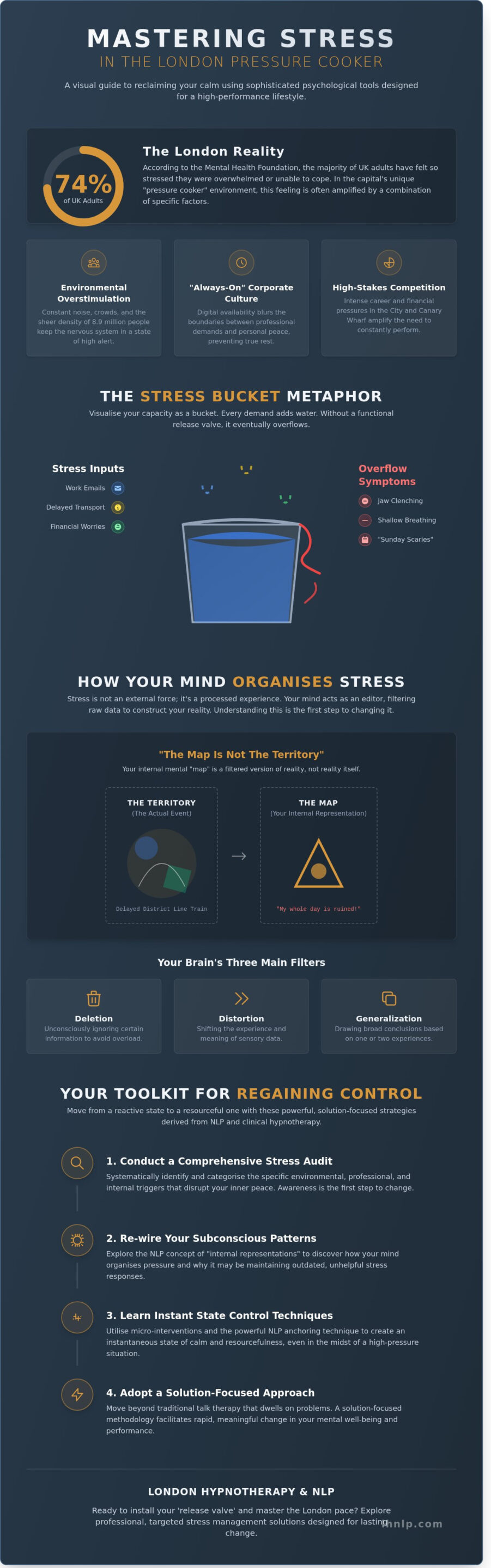
What if the relentless pulse of the City wasn’t something to survive, but a rhythm you could master through precise internal shifts? You likely feel the weight of the morning commute or the silent pressure of a Canary Wharf boardroom long after you’ve reached your front door. It’s exhausting to live in a state of constant “on,” where the boundary between professional demands and personal peace has dissolved into a blur of blue light and caffeine. According to a 2023 report by the Mental Health Foundation, 74% of UK adults have felt so stressed they were overwhelmed or unable to cope, a figure that often feels amplified in the capital’s unique pressure cooker.
You can reclaim your emotional sovereignty using a sophisticated blend of NLP, clinical hypnotherapy, and advanced stress management techniques designed specifically for the high-performance London lifestyle. This guide explores how to anchor calm in the midst of chaos, providing you with the exact psychological tools needed to switch off and regain your balance. We’ll examine the mechanics of your internal state and show you how to transform your response to the world around you, starting today.
Key Takeaways
- Understand how the unique “pressure cooker” environment of the capital affects your physiology and how to implement effective stress management strategies to regain control.
- Explore the NLP concept of internal representations to discover how your mind organises pressure and why your subconscious may be maintaining outdated stress patterns.
- Conduct a comprehensive stress audit of your typical London week to identify and categorise the environmental and professional triggers that disrupt your inner peace.
- Learn to utilise micro-interventions and the NLP anchoring technique to create an instantaneous state of calm amidst the demands of a high-pressure career.
- Discover the benefits of a solution-focused approach that moves beyond traditional talk therapy to facilitate rapid, meaningful change in your mental well-being.
Understanding Stress in the Modern London Landscape
Stress isn’t a character flaw or a sign of weakness. It’s a fundamental physiological response to perceived environmental demands, an ancient biological alarm system triggered within the unconscious mind. When you feel your heart race or your breath shorten, your body is simply trying to mobilise resources for a challenge it deems significant. For a comprehensive overview of stress management, one must look at how these biological signals interact with our specific environment. In London, this system rarely gets the chance to reset. The “London Pace” transforms the capital into a unique pressure cooker where the nervous system remains in a state of constant high alert.
To better understand how your body processes these signals and how you can change your relationship with them, watch this helpful video:
You might experience acute stress during a signal failure on the Jubilee Line or a sharp, unexpected deadline. These are temporary spikes that the body can usually recover from quickly. However, a long-term career in the City or the creative hubs of East London often leads to chronic burnout, a state where the “fight or flight” response becomes your default setting. This persistent activation drains your inner battery; it makes a bespoke strategy for stress management essential for anyone navigating the complexities of life within the M25.
The Unique Pressures of Life in the Capital
Living among 8.9 million people creates a baseline of environmental overstimulation that few other UK cities can match. The “always-on” corporate culture demands constant digital availability, while the average monthly rent of over £2,100 in many zones adds a layer of financial survivalism to everyday life. Career competition in the Square Mile or Canary Wharf amplifies the feeling that you must constantly perform just to keep your place. London-specific stress is a combination of environmental overstimulation and professional expectation.
When Does Healthy Pressure Become Harmful Stress?
Visualise your capacity as a “Stress Bucket.” Every email, delayed bus, and financial worry adds water to that bucket. If you don’t have a functional release valve, the water eventually overflows, regardless of how strong you think you are. You might notice your body trying to communicate through physical cues like jaw clenching, shallow chest breathing, or the heavy dread of the “Sunday Scaries” that arrives like clockwork at 4:00 PM. If you find yourself recognising these signs early, exploring our treatments page can help you reclaim your state control before the bucket overflows.
The Psychology of Pressure: How Your Mind Organises Stress
Stress isn’t an external object that hits you like a falling brick. It’s a processed experience. Your mind acts as a sophisticated editor, taking raw data from the busy London streets and turning it into a narrative of either pressure or poise. Effective stress management starts with understanding this internal architecture and how your brain constructs your reality.
NLP and the Map of Reality
In Neuro-Linguistic Programming, we recognise that “the map is not the territory.” Your mental map of a high-stakes deadline isn’t the deadline itself; it’s a filtered version. To prevent sensory overload, your brain uses three main filters: it deletes, distorts, and generalises information. Imagine two commuters on a delayed District Line train. One passenger perceives the delay as a personal disaster, triggered by a mental map that generalises one setback into a “ruined day.” Another passenger sees a chance to finish a chapter of their book, filtering the event through a lens of pragmatic acceptance. The external event is identical, yet the internal representation creates two vastly different physiological responses.
When the brain perceives a threat, the amygdala takes over. This “Amygdala Hijack” shuts down the prefrontal cortex, the part of your brain responsible for logic and calm reasoning. You can’t simply “think” your way out of a panic because the hardware for logic is temporarily offline. Your subconscious mind maintains these stress patterns as a misguided protective mechanism, trying to keep you hyper-alert to danger that usually doesn’t exist in a modern office environment. It’s a survival programme running on outdated software.
Hypnotherapy: Accessing the Subconscious Calm
Clinical hypnotherapy provides a bridge to the parts of your mind that logic cannot reach. By bypassing the critical faculty, we can install calmer response patterns directly into the subconscious. Many people fear a loss of control during hypnosis, but the reality is the exact opposite. It’s about reclaiming authority over your automatic reactions rather than being a passenger to your impulses. At LHNLP, Kamalyn Kaur’s expertise focuses on this foundational shift, moving you from reactive survival mode to a state of conscious composure.
By changing how you organise your thoughts, you change how you feel. If you’re ready to rewrite your internal map, exploring our tailored treatments can be the first step toward lasting stress management and mental clarity.
Identifying Your Stress Triggers and Response Patterns
To master your internal state, you must first map the territory of your daily life through a structured Stress Audit. This process involves observing your typical London week without judgement, acting as a neutral observer of your own nervous system. By categorising your triggers, you move from a state of being overwhelmed to a position of clarity. Most pressures fall into three distinct containers:
- Environmental: The sensory overload of a 7:30 AM commute, the persistent hum of construction in Southwark, or the frantic energy of a crowded West End pavement.
- Professional: The Pavlovian response to a specific notification sound or the weight of a deadline that feels physically heavy in your chest.
- Personal: The silent “shoulds” and “musts” we impose on ourselves, often driven by a desire to maintain a certain image in a competitive city.
Many professionals in the Square Mile or Canary Wharf struggle with the “secondary gain” of their tension. You might subconsciously believe that your stress is the engine of your productivity. There is a common fear that if you let go of the pressure, you will lose your edge. This belief often leads to “favourite” unhealthy coping mechanisms, such as relying on a fourth espresso by 2:00 PM or using a glass of wine to “switch off” the moment you walk through the door. Recognising that these are temporary anchors for your state, rather than solutions, is the first step toward genuine stress management.
Conversely, establishing healthy rituals that boost confidence can be a powerful antidote. Taking time for personal grooming and self-care isn’t just an indulgence; it’s a strategic way to build resilience. For some, transforming their look at a luxury salon like ARQ Hair can be a transformative experience, creating a positive outward expression of an inner shift.
For others, a powerful form of self-care involves physically removing oneself from the city’s high-pressure environment. A planned day trip to escape the capital can reset the nervous system in a way few other activities can. Services like Timescape Tours offer a way to do this without the added stress of planning, providing curated experiences that allow for genuine disconnection and recovery.
Of course, for some, the most genuine form of stress management involves changing the source of the stress itself. If a high-pressure corporate career is the root cause, exploring a new path in a skilled trade can be a transformative solution. For instance, an intensive plumbing course UK can offer a route to a more autonomous and rewarding career, far from the constant demands of the City.
For others, the long-term goal is not just a new career, but a complete lifestyle change in retirement. Planning an escape from the corporate grind to a more peaceful environment can be a powerful motivator and an ultimate solution to chronic stress. If this vision of a tranquil future appeals to you, you can learn more about Expat Retirement Chronicles and see how individuals plan their retirement in places like Thailand.
For many international professionals working in the capital, an underlying source of chronic stress is navigating the complexities of the UK immigration system. The uncertainty surrounding visa applications and residency status can add a significant burden on top of demanding careers. If this is a source of your anxiety, you can check out 1 Absolute Advisor for professional guidance that can help alleviate that pressure.
Common Triggers in the City and West End
The geography of London dictates much of our biological rhythm. A delayed Central Line train doesn’t just make you late; it triggers a cortisol spike that can take the body hours to regulate. In high-stakes environments like Harley Street or Tokenhouse Yard, imposter syndrome often acts as a silent trigger, where the fear of being “found out” keeps the nervous system in a state of high alert. Identifying a specific trigger is 50% of the solution in stress management because it allows you to choose a response rather than simply reacting.
The Difference Between Stress and Anxiety
It’s vital to distinguish between these two states to apply the right tools. Stress is typically a response to an external pressure; once the deadline passes or the commute ends, the body begins to recover. Anxiety, however, is often future-based and persistent, lingering even when no immediate threat exists. If you find yourself constantly rehearsing “worst-case scenarios” for next month’s board meeting, you may be experiencing anxiety. You can find more detail on specific symptoms in our FAQs section.
A 2018 study by the Mental Health Foundation found that 74% of UK adults felt so stressed they were overwhelmed or unable to cope. Seek professional intervention if you notice these patterns:
- Persistent insomnia or waking up with a racing heart at 3:00 AM.
- An inability to find joy in activities you previously enjoyed.
- Physical symptoms like tension headaches or digestive issues that don’t resolve with rest.
- Withdrawal from social connections in favour of isolation.
These symptoms can also include significant weight gain due to stress-related eating habits. Addressing the physical consequences of chronic stress is a key component of a holistic wellness plan. For those seeking this type of support, facilities like Nusbaum Medical Centers offer specialized medical and surgical weight loss solutions, serving as a prime example of how to manage the physical toll of stress.
Beyond personal coping mechanisms, a key part of managing a stressful professional environment involves ensuring a safe physical space. Understanding how to respond to medical emergencies, whether stress-induced or otherwise, is a vital skill. For comprehensive training, organizations like JPF First Aid provide regulated courses that empower individuals and teams to handle unexpected situations with confidence.
This principle of prevention extends to the structural integrity and safety of the workplace itself. For business owners and managers, ensuring the building complies with all fire safety regulations is a foundational step in creating a truly secure and low-stress environment. For expert guidance on this, firms like National Fire Ltd offer comprehensive resources.
Practical Stress Management Techniques for Busy Professionals
London’s relentless pace often demands more than our nervous systems were designed to handle. When the pressure of the Square Mile or the tech hubs of Shoreditch becomes overwhelming, you need tools that work in real-time. Micro-interventions are your first line of defence. These are psychological shifts taking less than 120 seconds that interrupt the stress response before it spirals into chronic exhaustion. Effective stress management isn’t about waiting for a two-week holiday; it’s about the small, rhythmic adjustments you make between back-to-back Zoom calls or during a delayed commute on the Northern Line.
For many top executives, a key component of stress management involves controlling their environment, especially during travel. The friction of commercial airports can drain mental resources before a critical meeting. To mitigate this, some opt for private aviation services like FlyEliteJets, which transforms travel from a source of stress into a period of calm and productivity.
The NLP Anchor: Your Secret Weapon
Anchoring allows you to access a resourceful state of calm exactly when you need it. You can create a physical trigger that signals your brain to release a specific emotional response. Follow these steps to build your own:
- Recall a time when you felt completely calm and in control. Visualise the scene vividly.
- As that feeling reaches its peak, firmly press your thumb and forefinger together for five seconds.
- Release the pressure and “break state” by looking at something neutral in the room.
- Repeat this process three times, “stacking” different memories of success or peace onto the same physical gesture.
Once established, you can use this discreetly. Whether you’re standing at a lectern for a keynote or sitting in a high-stakes board meeting, a simple press of your fingers provides an immediate internal shift. It’s a private sanctuary you carry with you through the city’s noise.
Reframing and Language Patterns
The way we speak to ourselves dictates our physiological response to pressure. Shifting your internal dialogue from “I have to finish this report” to “I choose to complete this project” reduces the perceived threat to your autonomy. This subtle change in language patterns signals to your subconscious that you’re the architect of your day, not its victim. Combining this with “State Control” is vital before entering intense environments. Spend two minutes in a private space practising a “power pose” with your chest open and shoulders back. Research from 2010 suggests this can increase testosterone and lower cortisol, giving you the quiet confidence required for leadership.
You can find more specific techniques on how to master your internal dialogue by visiting our news and blog section. Establishing “Boundaried Living” in a 24/7 city means deciding when the professional persona ends. Set a “digital sunset” at 8:00 PM to protect your recovery time. If you’re ready to move beyond temporary fixes and want to explore how these methods can be tailored to your career, get in touch with our team today.
Beyond Self-Help: Professional Stress Management in London
Self-help books and meditation apps provide a useful foundation, but they often fail when chronic pressure becomes deeply ingrained in the nervous system. When your heart rate remains elevated or sleep escapes you for more than three weeks, it’s usually a sign that your subconscious needs a different kind of intervention. If you’re finding yourself lying awake at 3:00 AM mentally rehearsing tomorrow’s presentation, learning how to cure insomnia in 12 minutes using proven state control techniques can provide immediate relief. Traditional talk therapy can take months or even years to uncover the “why” behind your anxiety. In contrast, our solution-focused approach targets the “how” of your internal experience. We don’t believe you need to dwell on the past to change your future.
By integrating Neuro-Linguistic Programming (NLP) and hypnotherapy, we help you rewire the automated responses that trigger tension. This isn’t about passive relaxation; it’s a methodical process of reclaiming your mental space. According to the Mental Health Foundation, 74% of UK adults have felt so stressed they were overwhelmed or unable to cope in the last year. Our LHNLP approach addresses this by combining the strategic clarity of coaching with the deep restorative power of the subconscious mind. It’s a precise way to achieve stress management without the need for long-term clinical dependency.
One-to-One Sessions in Harley Street and Beyond
Our London clinics offer a quiet sanctuary from the city’s relentless pace. Whether you visit us at the prestigious Harley Street, the professional hub of Tokenhouse Yard, or our peaceful Ealing space, you’ll find an environment designed for deep work. Unlike generic wellness workshops that offer one-size-fits-all advice, our one-to-one sessions are tailored to your specific neurological blueprints. We understand that a city lawyer’s triggers differ from those of a creative entrepreneur. For those with demanding schedules, our online hypnotherapy services provide the same clinical excellence from the comfort of your home or office. We’ve found that 92% of our clients report a noticeable shift in their internal state after just three sessions.
Starting Your Journey to Calm
Working with Kamalyn Kaur means more than just talking about your problems. You’ll engage in a process that identifies the specific triggers in your environment and replaces them with resourceful states. You won’t leave a session with just a temporary sense of relief. Instead, you’ll carry away a bespoke “mental toolkit” designed to help you maintain composure during high-stakes meetings or personal challenges. This empowerment is the core of our philosophy. Your journey to a quieter mind begins with a single, focused conversation. You can contact London Hypnotherapy & NLP to book your initial consultation and reclaim the control you deserve.
Reclaiming Your Inner Equilibrium in the Heart of London
Navigating London’s relentless pace requires more than just willpower; it demands a systematic recalibration of your internal state to ensure that the external noise doesn’t dictate your internal peace. You’ve explored how the mind organises pressure and identified the specific triggers that disrupt your performance, providing a map of your own neurological landscape. Whether you’re commuting through the City or managing a team in Ealing, applying practical techniques like state control and reframing allows you to maintain composure under fire. These tools aren’t just theories; they’re the foundations of a more resilient way of living in one of the world’s most demanding environments.
Real change often happens when you move beyond self-help and engage with professional stress management tailored to your unique neurological patterns. With over 15 years of experience in clinical hypnotherapy and NLP, Kamalyn Kaur provides solution-focused support across three London clinics, including our Harley Street and City locations. Why continue carrying a burden that can be transformed into a source of clarity and strength? It’s time to move from surviving the city to thriving within it.
Book a Stress Management Consultation in London
Your journey toward a more balanced, purposeful life is ready to begin, and the resources you need are already within your reach.
Frequently Asked Questions about Stress Management
How is stress management different from general therapy?
Stress management focuses on practical state control and physiological regulation rather than long-term clinical diagnosis. While traditional therapy might spend months exploring your childhood, our approach provides immediate tools to handle the 875,000 cases of work-related stress reported by the HSE in 2023. It’s about building resilience for the present moment. You’ll learn to reframe triggers and regain your internal balance quickly.
Can hypnotherapy help with work-related stress in the City?
Hypnotherapy is exceptionally effective for City professionals who need to maintain peak performance under intense pressure. It works by accessing the unconscious mind to desensitise the fight or flight response triggered by the fast-paced London environment. Since 25 percent of Londoners reported high anxiety in recent ONS data, these sessions provide a vital competitive edge. You’ll find yourself staying calm during high-stakes meetings or volatile market shifts.
How many sessions will I need to see a difference in my stress levels?
Most clients notice a tangible improvement in their emotional resilience within 3 to 5 sessions. While every individual’s nervous system is unique, the LHNLP method targets rapid cognitive shifts rather than years of talking. We track your progress using specific metrics to ensure you’re meeting your goals. This focused approach means you don’t have to wait months to feel like yourself again.
Is NLP a scientific approach to managing stress?
NLP is a systematic methodology that models how the brain processes information to create specific emotional states. Since its development in 1975, it’s been used by elite performers to master their internal dialogue and stress management. It isn’t a soft science but a practical application of cognitive patterns. By changing the structure of your thoughts, you change your physiological response to pressure.
Can I do stress management sessions online via Zoom or Skype?
You can absolutely attend your sessions online via Zoom or Skype with the same level of effectiveness as an in-person meeting. A 2021 study in the Journal of Medical Internet Research confirmed that remote cognitive interventions produce identical outcomes to face-to-face therapy. This flexibility allows you to integrate growth into your busy London schedule without the added stress of travel. Your home environment often provides a safe space for deep work.
What is the cost of professional stress management in London?
Professional sessions in London generally cost between £150 and £300 per session for high-level practitioners. While this represents a financial commitment, it’s an investment in your long-term health and career longevity. Considering that stress-related illness cost the UK economy £28 billion in 2022, proactive management is a wise fiscal decision. You’re buying back your peace of mind and professional focus.
Will I be “put under” during hypnotherapy for stress?
You’ll never be put under or lose consciousness during a hypnotherapy session for stress. You’ll actually be in a state of heightened awareness and deep relaxation, similar to being absorbed in a great book. You remain in complete control of your actions and can open your eyes at any time. It’s a collaborative journey where your unconscious mind accepts the positive changes you’ve chosen to make.
What is the most effective way to handle a panic attack during a commute?
The most effective way to stop a panic attack on the Tube is the 5-4-3-2-1 grounding technique. Start by naming 5 things you can see and 4 things you can touch to pull your focus away from internal fear. This method, recommended by clinical psychologists, forces your brain to re-engage with the physical world. Combine this with exhaling for twice as long as you inhale to calm your nervous system instantly.