

What if avoiding burnout isn’t about becoming better at coping, but about changing what keeps draining you? If work follows you into evenings and weekends, or a night’s rest no longer brings your energy back, it can be hard to tell whether you’re simply tired or slipping into a more serious pattern. Learning how to avoid burnout in a demanding job starts with noticing those changes, not blaming yourself for having limits.
A demanding role can take a real toll, especially when the workload or expectations leave too little room to recover. Personal habits can help, but they can’t always resolve workplace pressures on their own. There are practical steps you can take, and asking for changes or support is a considered response, not a failure.
This guide will help you recognise early shifts in your energy, mood and relationship with work, build recovery into a busy routine, and identify when to speak with your manager, someone you trust or a professional. You’ll also find ways to respond when the demands themselves need to change.
Key Takeaways
- Spot developing burnout by tracking changes in your energy, mood and relationship with work, rather than judging yourself by one difficult day.
- Understand how workload, unclear priorities, limited control and emotional strain can all reduce your capacity to recover.
- Learn how to avoid burnout in a demanding job with personal adjustments and workplace changes, rather than relying on resilience alone.
- Build a practical weekly plan around the pressures you can influence, with steps that can adapt to different schedules and responsibilities.
- Recognise when persistent effects on sleep, mood or concentration are a reason to seek support from someone you trust, your workplace or a mental health professional.
How to Avoid Burnout in a Demanding Job: Notice the Early Pattern
Sustained pressure can affect even capable, committed people. You may care deeply about your work and still find that your energy, patience or concentration is wearing thin. Recognising that shift isn’t an admission of weakness; it’s a way to understand what your working conditions are asking of you before strain becomes harder to manage.
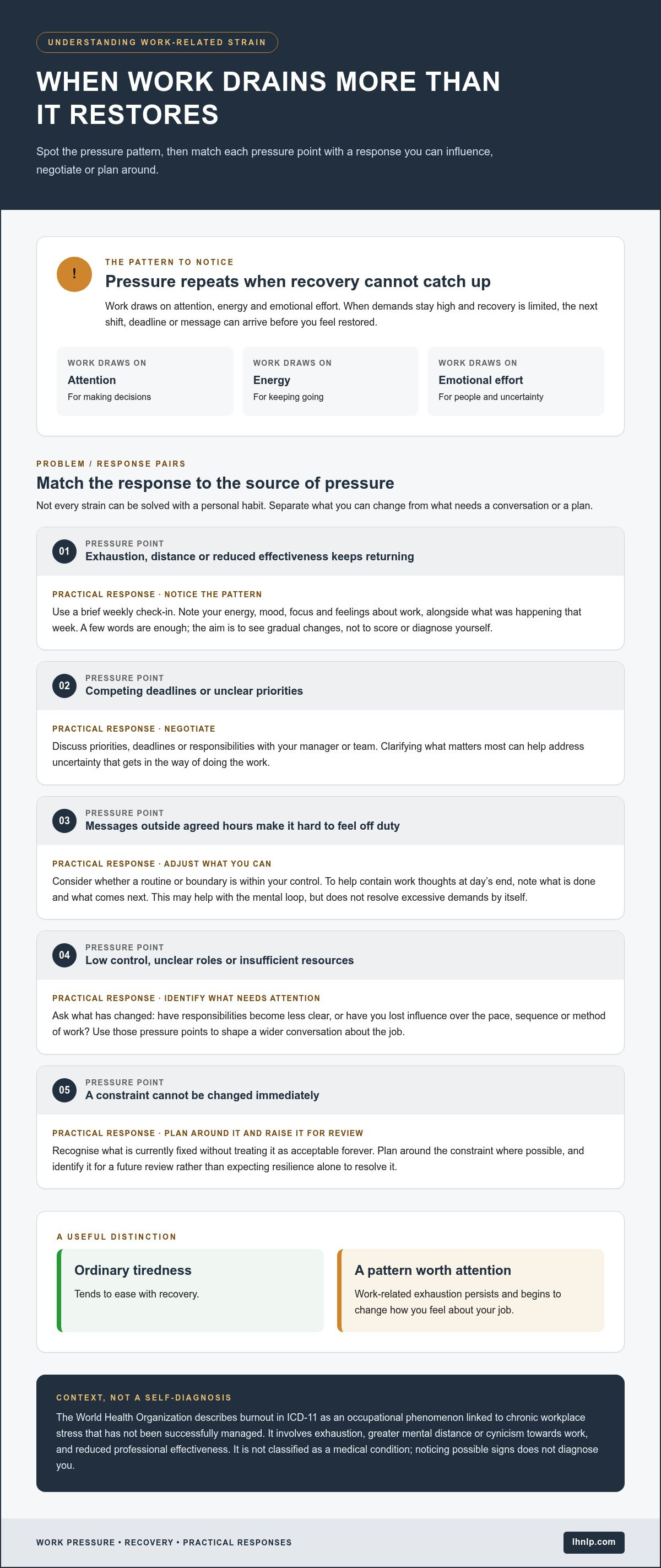
The World Health Organization describes burnout in ICD-11 as an occupational phenomenon linked to chronic workplace stress that hasn’t been successfully managed. It involves exhaustion, greater mental distance or cynicism towards work, and reduced professional effectiveness. It isn’t classified as a medical condition, and noticing possible signs doesn’t diagnose you. For more background, see Understanding Occupational Burnout.
Ordinary tiredness tends to ease with recovery; work-related exhaustion that persists and begins to change how you feel about your job deserves closer attention.
Which changes might signal that work is taking too much?
Look for a pattern, not a perfect match with a list. You might feel depleted before the working day begins, struggle to switch off afterwards, or find that time away doesn’t restore you as it once did. Work you previously approached with interest may now bring dread, detachment or irritation. Tasks can also start to feel harder to complete, even when you’re putting in more effort.
A demanding deadline or shift can leave anyone tired for a while. The useful question is whether you recover as the pressure passes, or whether exhaustion, distance and doubts about your effectiveness keep returning or intensifying. One difficult day isn’t proof of burnout. A cluster of changes that lasts, affects daily life or feels unlike you is a reason to pause and seek perspective.
Try a brief weekly check-in: note your energy, mood, focus and feelings about work, alongside what was happening that week. A few words are enough. The aim isn’t to score yourself or self-diagnose, but to make gradual changes easier to see. If your notes show a worsening pattern, take that observation seriously.
Why can two people respond differently to similar demands?
Workload matters, but it doesn’t act alone. The same volume of work can feel different depending on how much control you have over priorities, whether expectations are clear, and whether you have the time, tools and support to do the job. Emotional demands, changes outside work, previous experiences and opportunities to recover can all shape how pressure lands.
That means burnout isn’t simply a measure of someone’s character or resilience. If you feel stretched, ask what has changed: have deadlines multiplied, responsibilities become less clear, or breaks and personal time become harder to protect? Consider changes outside work, too, without assuming they’re the whole explanation. This fuller picture can help you identify where pressure is coming from and what might need attention as you explore how to avoid burnout in a demanding job.
Why Demanding Work Can Outpace Your Capacity to Recover
Work draws on more than the hours in your diary. It uses attention to make decisions, energy to keep going and emotional effort to respond to people or uncertainty. When demands remain high, you may finish the day with little left to restore those resources. If the next shift, deadline or message arrives before recovery has caught up, you begin under pressure rather than from a steady baseline.
Repeated pressure becomes harder to sustain when recovery is too limited to replenish what work continually draws upon.
This cycle isn’t a sign that you’re managing your time badly. It can be shaped by the job itself, by responsibilities outside work, or by the way these pressures overlap. A poor night’s sleep, for example, may make a complex task feel more demanding; worry about unfinished work can then make it harder to switch off the following evening.
Which job conditions can keep pressure switched on?
Workload volume is only one part of the picture. Competing deadlines can force constant trade-offs, while unclear priorities leave you guessing what matters most. Unpredictable availability, such as messages arriving outside agreed hours, can make it difficult to feel off duty. Role ambiguity or insufficient resources may also mean spending energy resolving avoidable uncertainty instead of doing the work itself.
Low control can add another layer: a demanding workload is often more draining when you can’t influence its pace, sequence or method. To understand your own pressure points, sort them into three groups:
- Changeable: a routine, boundary or task sequence you can adjust yourself.
- Negotiable: priorities, deadlines or responsibilities you could discuss with a manager or team.
- Currently fixed: constraints you can’t alter immediately, but can plan around or raise for future review.
This isn’t about accepting unfair conditions. It helps distinguish where a small personal adjustment may help from where the job needs a wider conversation or change.
Why is recovery more than time away from your desk?
Stopping work and mentally disengaging from it aren’t always the same. You may close your laptop but keep replaying a difficult conversation or mentally sorting tomorrow’s tasks. A clear end-of-day note about what is done and what comes next can sometimes help contain that loop, though it won’t resolve excessive demands on its own.
Recovery is supported by more than one kind of pause: restorative sleep, breaks during the day, time with supportive people, and periods when you’re genuinely free from work expectations. What feels restorative will differ between people and circumstances. A brief quiet break may help during a shift; someone with caregiving responsibilities may need realistic pockets of uninterrupted time rather than an idealised evening routine.
No single habit guarantees protection from burnout, particularly if the conditions creating strain remain unchanged. If you want individual support with stress-management goals, one-to-one hypnotherapy and NLP sessions may be an option to explore alongside practical changes at work.
Is Burnout Prevention Only About Being More Resilient?
Planning your day, protecting breaks and practising resilience can make a demanding week more manageable. But these tools have limits. If the workload cannot be completed in the available hours, priorities constantly conflict or a team is chronically short-staffed, better personal organisation won’t fix the underlying problem. Burnout prevention is more balanced when it considers both what you can adjust and what needs attention at work.
For a clearer way to think about stress management strategies at work, start by separating individual choices from workplace conditions. The distinction isn’t about deciding that one side matters more. It helps you act where you have influence without taking responsibility for problems you can’t solve alone.
What can you adjust yourself, and what needs a work conversation?
Some changes are within your control; others call for shared decisions. Use this comparison as a starting point, not a rule that every workplace concern can be resolved through one conversation.
| Possible individual adjustments | Workplace concerns to discuss |
|---|---|
| Plan key tasks, group similar work, or build a short pause into the day. | Deadlines that remain unrealistic despite careful planning. |
| Set notification boundaries where your role allows, and clarify when you’ll respond. | Conflicting priorities, unclear ownership or expectations that keep changing. |
| Ask for clarification when a task’s scope is uncertain. | Chronic understaffing or a workload that exceeds available capacity. |
A useful test is to ask: Could I change this without another person’s agreement? If yes, try a small adjustment and notice whether it helps. If not, or if the same obstacle keeps returning, it may need a conversation with your manager or team. Individual actions can support your wellbeing, but they don’t make you responsible for fixing systemic conditions.
How can you raise workload concerns constructively?
Make the conversation specific. Beforehand, note the tasks competing for your time, their deadlines, what depends on what, and what may be affected if everything stays urgent. For example: “I can complete the client report or the revised forecast by Friday. Which should take priority?” This gives your manager a clear decision to make without asking you to silently absorb the conflict.
Ask for agreement on what will be done first, what can move, and whether responsibilities need reviewing. If the next steps are unclear, suggest a follow-up date to check whether the workload has become manageable. A defined review is more useful than relying on a general promise to revisit things later.
Learning how to avoid burnout in a demanding job doesn’t mean becoming endlessly adaptable. If personal changes aren’t enough, individual support focused on stress management may help you explore practical ways to respond alongside appropriate workplace action.
How to Build a Burnout-Prevention Plan Around a Busy Workweek
A useful plan isn’t another demanding project to complete perfectly. It’s a small structure for noticing what drains you, making room for recovery where possible and responding when pressure keeps building. If you’re exploring how to avoid burnout in a demanding job, start with steps that fit the week you actually have, not an ideal schedule you can’t control.
Try this sequence, adapting it around shifts, remote work, caring responsibilities or other fixed commitments:
- Notice the pressure points. At the start of the week, jot down the tasks, shifts or interactions you expect to take the most effort. Note what feels changeable and what depends on someone else.
- Identify demanding periods. Mark the busiest parts of your working pattern. If you can, protect a short pause before or after them, even if that means a quiet moment between tasks rather than a scheduled break.
- Choose one practical adjustment. You might group similar tasks, prepare what you need for a shift, or agree which task takes priority. Keep the change small enough to try without adding pressure.
- Create an end-of-work marker. At a natural stopping point, write down what’s complete and the next action for unfinished work. If your role involves handovers, use that exchange to clarify what carries over and what doesn’t.
- Make room for personal recovery. Choose something restorative and manageable, such as a short walk, an unhurried meal or time with someone supportive. If caregiving limits your free time, look for a realistic pocket of rest rather than aiming for a perfect routine.
- Review the week briefly. Note what happened to your workload, recovery and energy. A few words are enough. Keep what helped, and choose one adjustment to test next week.
What can you put into a realistic weekly plan?
Let your circumstances shape the plan. A shift worker might anchor a wind-down routine to the end of a shift instead of a particular clock time. Someone working remotely could use a closing note or a change of room to mark the transition. If you have little control over breaks, look for the small pauses your role allows. The aim is a workable rhythm, not a rigid timetable.
What if deadlines and demands cannot be reduced immediately?
Make trade-offs visible. Ask your manager which essential task should come first, then break the chosen priority into a clear next action and agree when to check progress. At the weekly review, ask whether the plan made the pressure more manageable. If it didn’t, change one element or raise what remains unsustainable; you don’t have to redesign your whole life to learn something useful.
If working on stress feels difficult to manage alone, explore individual stress-management support as one possible next step alongside practical changes to your workload and recovery.
When to Seek Support for Burnout and Stress
You don’t have to wait until you can no longer manage work or everyday life before asking for support. If sleep, mood, concentration or your ability to manage daily tasks is persistently affected, or the effects are getting worse, take that change seriously. There can be different reasons for these experiences, so avoid trying to diagnose yourself from a list of signs. A GP or mental health professional can help you consider what may be contributing and what support is appropriate.
Different kinds of support can meet different needs. A trusted person may offer a listening ear and help you feel less alone. A manager or appropriate workplace contact can discuss workload, priorities or adjustments to working arrangements. A GP or mental health professional can help explore ongoing distress and discuss care. These options can complement one another; you don’t need to choose only one.
When might self-guided changes not be enough?
Consider professional support if distress continues despite changes, becomes more intense, or interferes with sleep, relationships, responsibilities or other parts of daily life. You can describe what you’ve noticed, when it began and how it affects you, without needing a label for it. If you feel at immediate risk or unable to keep yourself safe, call 999 or go to the nearest A&E. For urgent advice in England, contact NHS 111.
What can one-to-one stress-management support involve?
Individual support can give you dedicated space to explore how stress shows up for you, what tends to trigger it and what you’d like to work towards. The focus can be shaped around your circumstances and pace, rather than asking you to follow a one-size-fits-all routine. Hypnotherapy and NLP treatments may be approaches to consider as part of personal stress-management goals; they aren’t a guaranteed way to prevent or resolve burnout, or a substitute for medical care when that’s needed.
If you prefer remote sessions, virtual hypnotherapy is another option for accessing individual support. The important point is that seeking help doesn’t mean you’ve failed to cope. It can be a thoughtful next step when carrying the strain alone no longer feels manageable.
Learning how to avoid burnout in a demanding job includes recognising when personal strategies aren’t enough and allowing other people to help. You might begin with one conversation: tell someone you trust what has changed, raise a specific work pressure with your manager, or speak with a healthcare professional about persistent effects. Start where it feels possible, and seek urgent help if your safety is at risk.
Take One Thoughtful Step Towards a More Sustainable Workweek
You don’t need to redesign your working life all at once. Choose one useful next step: make space for a genuine pause, raise a priority conflict, or tell someone you trust how work has been affecting you. Small actions can help you understand what needs attention, while lasting change may also depend on improving the conditions around you.
Learning how to avoid burnout in a demanding job isn’t about proving you can tolerate more. It’s about responding to your limits with care and making room for support before strain becomes harder to carry. If you’d value a space to explore your stress-management goals, individual sessions are available in person in London and virtually.
Explore individual stress-management support when it feels like a helpful next step. You can move at a pace that feels manageable, one considered choice at a time.
Frequently Asked Questions
Can you prevent burnout if your job is always demanding?
You may reduce the risk, but personal habits can’t guarantee protection if pressures remain unsustainable. Alongside planning recovery, look for ways to shape the demands: clarify priorities, raise capacity concerns and agree what can be delayed when new work arrives. If you’re wondering how to avoid burnout in a demanding job, consider both your own routines and whether the role needs changes. If workplace conditions cannot shift, seek support rather than treating the strain as a personal failing.
How do you know if you are experiencing burnout or ordinary work stress?
Consider whether the strain eases when a specific pressure passes, or whether it continues to affect you across work and home. For example, if you remain unable to concentrate during ordinary tasks after a deadline has ended, note that change and discuss it with a GP or mental health professional. Stress and burnout can overlap with other concerns, so symptoms alone can’t confirm the cause. A qualified professional can help you explore what’s happening.
Can taking annual leave prevent burnout?
Annual leave can provide valuable distance from work, but it may not be enough if you return to the same relentless workload or expectations. Before time off, consider whether unfinished tasks need a clear handover so you’re not carrying them mentally throughout your break. After returning, notice whether your energy lasts or quickly falls away. If work pressure builds again, the pattern may call for changes to responsibilities or workload, not just another spell away.
What should you do when your manager keeps adding urgent work?
Ask your manager to choose between competing priorities instead of accepting each new request as an addition to everything already due. You could say, “I can complete the client update today or the revised figures. Which should come first?” Keep a brief written note of new tasks, deadlines and agreed trade-offs. If urgent requests continue to exceed your capacity, request a conversation about workload and responsibilities, and involve an appropriate workplace contact if you need further support.
Can burnout affect people who enjoy their jobs?
Yes. Enjoying meaningful work doesn’t make someone immune to prolonged pressure, limited recovery or demands that exceed available capacity. A person may still value their role while feeling increasingly depleted, detached or unable to work as effectively as before. Try not to use your enthusiasm as proof that nothing is wrong. Ask instead whether the way the work is organised remains sustainable, and whether your energy and wellbeing have changed over time.
When should you seek professional help for work-related stress?
Speak with a GP or mental health professional if stress persists, worsens or interferes with sleep, concentration, relationships or everyday responsibilities. You don’t need to be certain that burnout is the cause before asking for help. In London, you can start by contacting your GP to discuss what you’re experiencing and appropriate support. If you’re in immediate danger or can’t keep yourself safe, call 999 or go to A&E.