

What if confidence at work isn’t about getting everything right, but about trusting yourself to respond when something goes wrong? The fear of making mistakes at work can turn routine decisions into long internal debates: you recheck finished tasks, put off unfamiliar work, or replay a small error long after it’s been resolved. It makes sense to want to do your job well. But care and self-punishment aren’t the same thing.
If a minor mistake leaves you feeling exposed or anxious, you’re not alone in finding it hard to move on. Fear can be shaped by perfectionism, past criticism, or a workplace where it doesn’t feel safe to ask questions or admit uncertainty. Understanding what’s fuelling it can help you respond with more perspective.
This article explores why mistakes can feel so threatening and how to stop fear from running every decision. You’ll learn practical ways to assess an error, choose a reasonable next step, and build self-trust without expecting perfection. We’ll also look at when persistent anxiety may be a sign that extra support, including one-to-one hypnotherapy or NLP, could be useful.
Key Takeaways
- Learn how fear of making mistakes at work can show up in everyday choices and what may be fuelling it.
- Use a simple pause-and-assess process to separate known facts from feared outcomes before deciding what to do.
- Build confidence gradually by taking manageable steps and clarifying expectations when a task feels ambiguous.
- Recognise when ongoing fear is affecting your work or wellbeing, and consider support as a practical option.
What Does Fear of Making Mistakes at Work Look Like?
You’re about to send a routine email, but pause to reread it for the fifth time. Or a small error from yesterday keeps replaying in your mind, even though you’ve corrected it. The fear of making mistakes at work can show up in these quiet moments, as worry about getting something wrong, being judged, facing consequences, or seeming less capable.
Some care is part of doing a job responsibly. The difference is often whether checking helps you complete the task or keeps you caught in doubt. Occasional mistakes are a normal part of working life; having them, or worrying about them sometimes, doesn’t by itself mean anything is wrong.
For a related perspective on fear and evaluation, watch this video:
When does carefulness become fear of getting it wrong?
Proportionate checking has a purpose: you review a figure, confirm the recipient, then send the work. Repeated checking may continue even when you’ve found no issue, bringing little lasting reassurance and making it harder to move on. You might avoid a decision or delay a task because not acting briefly eases the worry. Over time, though, that relief can come at the cost of participation and confidence.
Context matters. The appropriate level of care depends on your responsibilities, the consequences of an error, your experience, and how clearly expectations are communicated. A high-stakes task may warrant careful review; an unclear or punitive workplace can make even ordinary decisions feel risky. The aim isn’t to dismiss genuine responsibility, but to notice when fear is disrupting concentration or stopping you from completing work.
What might the fear feel like during an ordinary workday?
You may reread an email because you’re unsure how its tone will be received, or leave a straightforward submission in drafts while searching for one more reason to wait. A thought such as “If I get this wrong, they’ll think I’m incompetent” can bring tension, embarrassment, or a strong urge to seek reassurance. These experiences vary, and none alone is a diagnosis. They may be influenced by a fear of negative evaluation, a concept discussed in psychological literature.
Constructive caution checks what matters; fear-driven perfectionism keeps searching for certainty. If that distinction feels familiar, it can offer a useful starting point: notice whether your checking is helping you finish well or keeping you from finishing at all.
Why Can a Small Work Mistake Feel So Significant?
A minor error can quickly seem to mean more than “something needs correcting”. You might imagine a colleague losing trust, a manager questioning your ability, or one mistake harming your future at work. These outcomes aren’t inevitable, but when the mind treats them as plausible, an error can feel like a threat to belonging or competence rather than a specific problem to solve.
The fear of making mistakes at work can develop through several influences at once. Uncertainty about what’s expected may leave you guessing at the standard; high responsibility can make the consequences of an error feel weightier. Past criticism or a previous difficult experience may also shape what you expect to happen next. These are possible influences, not a single explanation that applies to everyone.
How perfectionism and self-criticism can reinforce the fear
Perfectionistic standards can make normal human error feel like proof of failure. With all-or-nothing thinking, work may seem either flawless or unacceptable, leaving little room for a reasonable learning curve. Perfectionism is a pattern of demanding flawlessness and judging yourself harshly when reality falls short, not a diagnosis.
Notice the difference between reviewing an outcome and condemning yourself. “I entered the wrong figure; I’ll correct it and check the source next time” identifies a specific issue and a useful adjustment. “I’m incompetent” turns one event into a verdict on your whole ability. The first response can guide learning; the second may deepen shame without showing you what to do.
How workplace pressure and past experiences may contribute
A tight deadline, unclear responsibilities, high-stakes work, or feedback delivered mainly when something goes wrong can all make errors feel more loaded. In a supportive setting, a correction may feel manageable. Where expectations are shifting or criticism is unpredictable, the same mistake might prompt greater worry. The context matters, as does your experience of it.
Earlier experiences can influence present expectations without defining them. Perhaps you learnt to associate mistakes with embarrassment, or you’re new to a role and still building confidence. Reflection can help you spot a pattern, but noticing one doesn’t prove that you have a clinical condition. Try asking: “What happened in this situation, and what am I predicting because of it?” That distinction can create room for a more proportionate view.
Once you can separate the event from the meaning you’ve attached to it, a clear next step may feel easier to find. Harvard Business Review offers practical guidance on how to handle mistakes professionally. If fear and self-criticism remain difficult to shift, one-to-one support for confidence and anxiety may be an option to explore.
How to Respond to a Work Mistake Without Spiralling
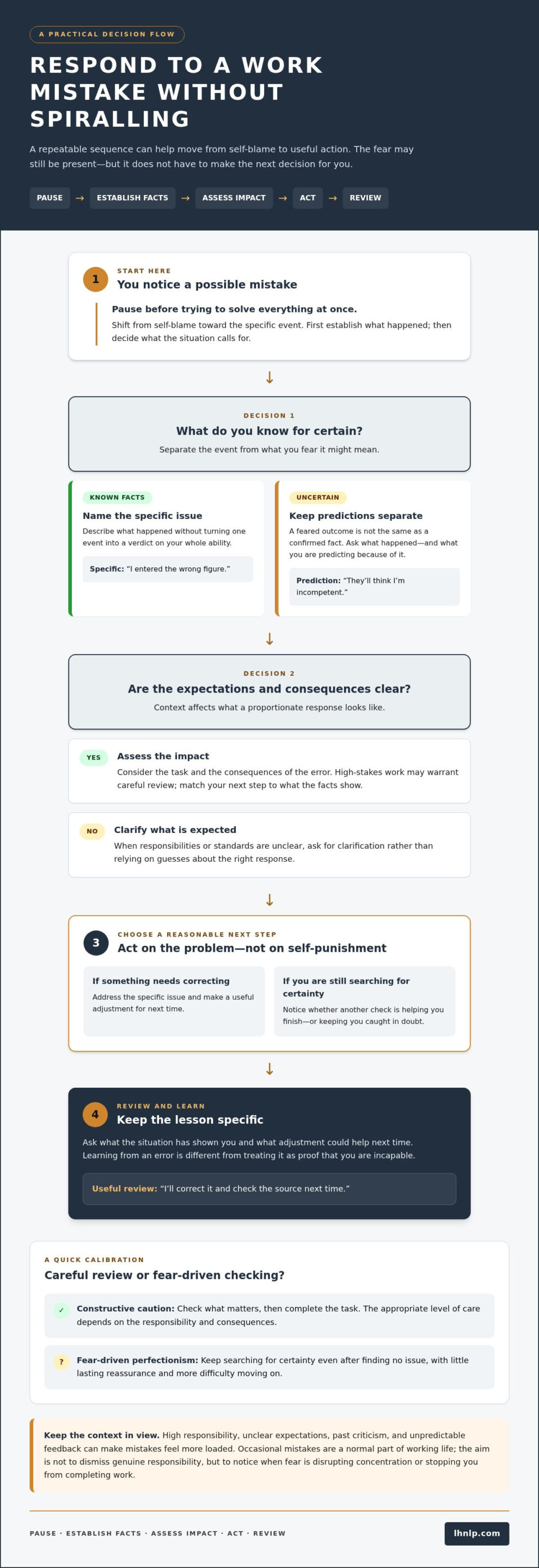
Discovering an error can trigger a rush of alarm, but you don’t have to solve everything at once. A repeatable sequence can help you move from self-blame to useful action: pause, establish the facts, assess the impact, act, then review what you’ve learnt. The fear of making mistakes at work may still be present, but it doesn’t have to make the next decision for you.
A five-step reset for the moment you notice an error
- Pause. If circumstances allow, take a moment and breathe slowly before responding. A brief pause can help you avoid reacting from panic.
- Establish the facts. Describe what happened in plain terms. What do you know, and what are you assuming? Check the relevant information rather than filling gaps with worst-case predictions.
- Assess the impact. Consider who or what may be affected, how time-sensitive the issue is, and whether there’s a risk that needs prompt attention.
- Act. Correct what you can, and involve the appropriate colleague or manager if the impact, your role, or workplace procedures call for it. Be direct and proportionate: “I noticed that I sent the earlier version of the file. I’m checking who received it and will send the corrected version now. I’ll let you know if anything else needs attention.”
- Review and return. Once the issue is addressed, note one practical prevention step, such as checking the file version before sending. Then bring your attention back to the next task.
Being accountable means addressing the real impact and communicating with the people who need to know. It doesn’t mean making a dramatic confession about every minor imperfection. Follow relevant workplace processes, and don’t minimise an error if someone may be affected.
How to replace harsh self-talk with useful review
After acting, turn a sweeping judgement into a specific question. Instead of “I’m hopeless at this”, ask, “What happened, what needs correcting, and what would help prevent a repeat?” Compare your feared outcome with the evidence you have, while staying open to genuine consequences that still need attention.
A learning-focused review might sound like: “I used an outdated figure in the draft. I’ve corrected it and will check the source document before sharing the next version.” This approach keeps responsibility clear without turning one action into a verdict on your ability. The Greater Good Science Center at UC Berkeley also shares ideas for how to overcome our fear of failure by learning from past setbacks.
If this pattern continues to make work feel difficult, exploring one-to-one support for confidence and anxiety may be a helpful next step.
How to Build Confidence When You Fear Getting Things Wrong
Confidence doesn’t require you to feel certain before every decision. It grows as you take reasonable action, notice what happens, and learn that you can respond if something needs adjusting. If the fear of making mistakes at work has led to avoidance or repeated checking, aim for gradual practice rather than demanding that you become fearless overnight.
Start with one manageable change. Choose a low-risk task where you can try a more proportionate approach, while keeping appropriate checks for work with serious consequences.
Practise tolerating uncertainty in manageable steps
Before the task, write down what you predict might happen if you don’t add an unnecessary extra check. Complete the work, then compare that prediction with the outcome. Perhaps a colleague asks for a small edit, or nothing needs changing. Either way, you’re gathering useful evidence about what happens when you act with reasonable care, not perfect certainty.
As this feels more manageable, choose another small step. Don’t use the exercise to skip essential reviews: match your checking to the task’s real impact and your responsibilities.
Create clearer expectations and a healthier review routine
Ambiguous tasks can make it difficult to know when work is good enough. Where expectations are unclear, clarify the scope, deadline, who can make decisions, and when a review is needed. For recurring tasks, turn what you learn into a short checklist. A consistent routine gives you a useful stopping point, instead of relying on another round of reassurance.
Keep a simple record of completed work and constructive feedback, not just errors. Looking back at what you’ve handled well can balance the mind’s tendency to treat mistakes as the only evidence that matters.
Progress is not never making a mistake. It’s being able to act thoughtfully while some uncertainty remains, and to make a sensible adjustment if new information appears. Choose one low-risk task for your next practice step.
If fear is making it hard to trust your judgement, explore one-to-one confidence-building support with London Hypnotherapy & NLP.
When Is Extra Support for Fear of Work Mistakes Worth Considering?
Self-help strategies can offer a useful starting point, but they don’t have to be the only option. If the fear of making mistakes at work keeps returning despite your efforts, or makes it difficult to do your job and enjoy life outside work, support may be worth exploring. That isn’t a judgement on your ability or proof that something is wrong. It’s one way to get help understanding the pattern and finding a path forward.
What signs suggest self-help may not feel sufficient?
Consider whether worry is taking up more space than you want it to. You might regularly avoid tasks or decisions, spend so long checking that work is hard to complete, or feel distressed before and after ordinary responsibilities. It may also be affecting your sleep, relationships, or ability to switch off beyond the workplace.
These signs aren’t a diagnosis. They can simply suggest that carrying the worry alone is becoming difficult. If your needs extend beyond the strategies discussed here, speaking with your GP or an appropriate mental-health professional can help you explore suitable support. Seek medical advice for concerns about your health, and use urgent services if you need immediate help.
How one-to-one support can fit into a personal approach
Talking through your experience with someone can help you look at what triggers the fear, how it affects your choices, and what you’d like to approach differently. London Hypnotherapy & NLP offers personalised one-to-one hypnotherapy and NLP sessions related to anxiety, confidence, and stress management. These approaches can be explored as part of an individual plan, without a promise of a particular result.
Appointments are available in person at London locations including Harley Street, Ealing, and Tokenhouse Yard, as well as virtually through Zoom and Skype. You can read more about the practice’s hypnotherapy and NLP treatments to consider whether this kind of support feels relevant to you.
There’s no need to wait until things feel unmanageable before exploring help. If fear is limiting your work or wellbeing, take a small next step: reflect on what you want support with, then explore an approach that feels appropriate for you. The aim isn’t to guarantee that you’ll never make a mistake. It’s to build a steadier relationship with uncertainty, responsibility, and your own ability to respond.
Build Confidence One Thoughtful Step at a Time
The fear of making mistakes at work can make ordinary decisions feel like tests of your worth. But confidence doesn’t depend on flawless performance. It can grow when you separate facts from feared outcomes, respond to errors with proportionate action, and practise moving forward with reasonable care even when some uncertainty remains.
Start small: choose one manageable task, clarify what’s expected, and use a sensible review routine. If worry keeps disrupting your work or wellbeing, seeking support is a valid option, not a sign of failure.
London Hypnotherapy & NLP offers personalised one-to-one sessions with practitioner Kamal, with in-person appointments across London and virtual consultations. Explore one-to-one hypnotherapy and NLP support as a possible next step.
You don’t need to become fearless before you act. Each considered step can help you build trust in your ability to handle what comes next.
Frequently Asked Questions
Why am I so afraid of making mistakes at work?
The fear of making mistakes at work can grow when an error feels linked to judgement, rejection, or your future career, rather than simply something to correct. Perfectionistic expectations, unclear instructions, high responsibility, or past criticism may contribute, alone or together. The cause isn’t the same for everyone. Noticing when the worry appears, and what you predict might happen, can help you understand the pattern without judging yourself.
Is it normal to worry about making mistakes at work?
Yes, it’s understandable to care about doing your job well and to feel concerned about an error sometimes. A mistake can have real consequences, so proportionate checking and prompt correction are part of responsible work. It may be worth giving the worry closer attention if it regularly disrupts concentration, delays tasks, or makes you avoid decisions. Occasional anxiety or an ordinary mistake alone doesn’t mean something is wrong.
How can I stop overthinking a mistake at work?
Separate what you know from what you fear might happen. Write down the facts, identify who may be affected, and decide whether a correction or conversation is needed. Once you’ve taken a reasonable step, note one lesson and return your attention to the next task. If you catch yourself replaying the event, ask, “Is there new information or action I need to take?” If not, practise letting the review end.
Can fear of making mistakes at work be related to perfectionism?
It can be. Perfectionistic standards may lead you to treat anything short of flawless work as failure, while all-or-nothing thinking can turn one error into a judgement about your overall ability. This isn’t the only possible cause, and perfectionism isn’t itself a diagnosis. Try replacing “I’m no good at this” with a specific review: “What needs correcting, and what would help me handle this task next time?”
What should I do after making a mistake at work?
Pause if circumstances allow, then establish what happened and assess the likely impact. Correct the issue if you can, and tell the relevant colleague or manager when the consequences, your responsibilities, or workplace procedures call for it. Be factual and clear about your next step. After addressing the issue, identify one practical lesson. Taking responsibility means responding appropriately, not attacking yourself or making a minor error larger than it is.
When should I seek help for fear of making mistakes at work?
Consider support if persistent worry, avoidance, or checking is making work difficult or affecting sleep, relationships, or life beyond work. You could speak with your GP or an appropriate mental-health professional if your needs extend beyond self-help. London Hypnotherapy & NLP also offers one-to-one hypnotherapy and NLP sessions related to anxiety, confidence, and stress, with in-person appointments in London and virtual consultations. Seeking support is an option, not a sign of failure.